
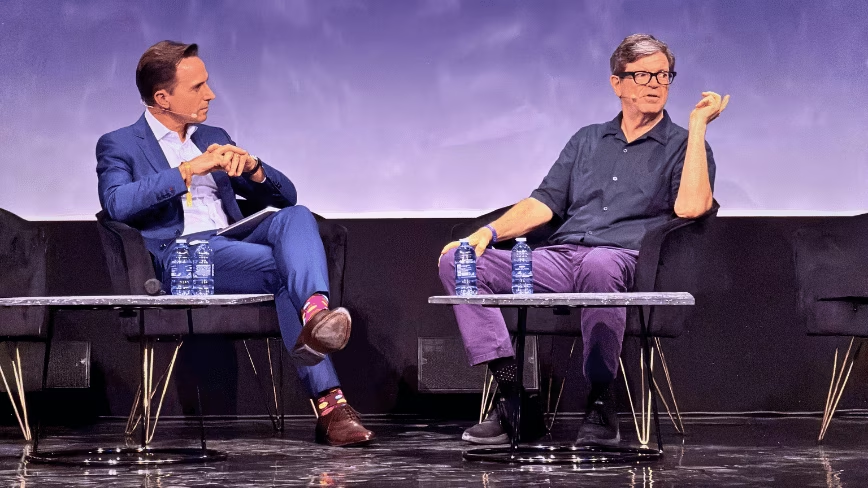
The Turing Award winner spent 12 years running Meta's AI lab, then quit to bet against the industry. At RAISE Summit in Paris, he argued that a child learns more about the world from watching it than the biggest chatbot learns from all the text online.
Yann LeCun is not a natural contrarian, but he is playing one right now. The man often called a godfather of AI built the convolutional neural network in the late 1980s. That design still powers phone cameras, medical scans, and driver-assistance systems.
He then spent 12 years as Meta’s chief AI scientist. In November, he told Mark Zuckerberg he was leaving. To build his alternative, he raised a reported $1bn seed round .
On stage at RAISE Summit in Paris, a day after his birthday, LeCun told Bloomberg’s Tom Mackenzie why. His new firm, AMI, is not chasing bigger chatbots. It is building “world models,” a different kind of AI meant to understand the physical world the way a child or an animal does.
LeCun’s core claim is blunt. Large language models are useful, but they will not get us to real intelligence. They handle sequences of symbols well. They pass exams, write emails, and summarise text. They do not understand the physical world.
The latest rumblings from the EU tech scene, a story from our wise ol' founder Boris, and some questionable AI art. It's free, every week, in your inbox. Sign up now!
His proof is what AI still cannot do. There are no Level 5 self-driving cars. There are no domestic robots. No machine can do what a 10-year-old can do, or even what a house cat manages. That gap, he argues, is the whole game. The tasks humans find trivial turn out to be the hardest ones for machines.
The reason, in his telling, is representation. A language model knows the world only through text, or through images turned into tokens and mixed with text. That misses most of what makes the physical world tick. Drop a bottle, and you know it will fall and maybe splash. You cannot predict every droplet, and that is the point.
This is where LeCun gets technical, and where he breaks with the mainstream. A language model predicts the next word by scoring every option in the dictionary. That works because the choices are finite. Video does not behave that way.
Try to train a system to predict the next video frame pixel by pixel, and it fails. Pan a camera across a room, then ask the model what comes into view, and it cannot know. There is simply too much unpredictable detail. So the model produces a blurry average, not a real prediction.
His answer is an approach he calls JEPA. Instead of generating every pixel, the system learns an abstract representation of a scene and predicts in that abstract space. It throws away the noise it could never guess and keeps the structure that matters. That, he says, is closer to how humans reason. We hold a mental model of reality and ignore the irrelevant detail.
A four-year-old beats the biggest model
LeCun’s most striking argument is about data. All the text on the internet adds up to roughly 10 to the power of 14 bytes. A person would need about 400,000 years to read it. A four-year-old child, through vision alone, has already taken in about the same amount.
In other words, a small child has seen as much raw data as the largest language model, and that data is video. It is redundant, but it is dense with how the world works. Children learn gravity, motion, and how objects behave, all without a single label. AMI’s video models, LeCun says, already spot when something impossible happens on screen. That is common sense, learned from watching.
LeCun was unusually candid about his exit. He said Mark Zuckerberg and Meta’s technology chief backed his research. The problem was direction. Through 2025, he said, Meta threw itself into catching up with rivals on large language models , on the belief that scale alone would deliver human-level AI. He does not believe that .
There was a practical mismatch too. The near-term uses of world models are industrial, he said: controlling complex systems, factories, and engines. Meta is a company built to connect people, not to sell process control. So it made sense to leave and go into high gear on his own. AMI now works on the self-supervised approach he championed for years.
A sovereign model for everyone else
LeCun used the stage to push a second idea, called Tapestry. It is a plan for an open foundation model that many countries could train together, without ever sharing their data.
The mechanics are federated. Each country, university, or company trains a model on its own data and its own hardware. It then sends only the resulting parameters to a central server, which averages everyone’s contributions into a shared model. The data never leaves home. The result, he argues, could beat closed models, because so much valuable data is private and would finally be put to use.
The stakes, for him, are cultural. Europe is behind in the model race, and the West no longer has a credible open platform, now that Meta has stepped back from Llama . That leaves open Chinese models, which could be restricted overnight by a political decision. He pointed to India, with its 22 official languages, as a country no US or Chinese lab will ever fully serve. If everyone’s information reaches them through a handful of foreign AI assistants, he warned, local language and culture lose out.
LeCun founded AMI in Paris on purpose, with further offices in New York, Montreal, and Singapore. He casts it as a global company rather than a national champion. His pitch to Europe is that the race is not lost.
Silicon Valley, he argued, is stuck in a trench. Everyone works on the same language-model recipe, and no one dares stray from it for fear of falling behind. That leaves an opening for anyone willing to try a different path. World models, in his view, are that path, and the next real AI revolution will come from understanding the world, not just predicting the next word.
Cristian Dina is the CRO at The Next Web. He has interviewed 300+ industry leaders and authored the book King of Networking, establishing hi (show all) Cristian Dina is the CRO at The Next Web. He has interviewed 300+ industry leaders and authored the book King of Networking, establishing himself as one of the most connected and respected voices in the ecosystem. At just 23 years old, Cristian was included in the Forbes 30 Under 30 2025 list, representing a new generation of tech builders, bold thinkers who move fast, build with purpose, and create real impact.