
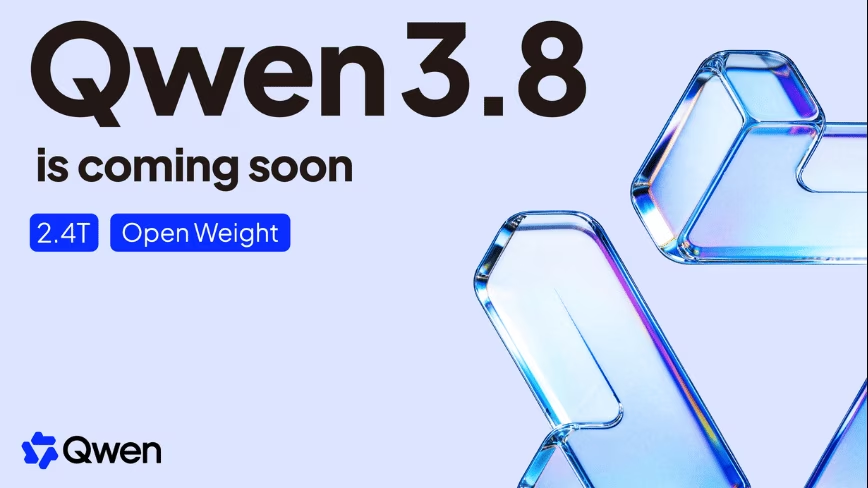
Alibaba says its new Qwen3.8 model is the second best in the world, behind only Anthropic's Fable 5. It has not shown a single benchmark to prove it, and the open weights are still weeks away.
Days after a rival Chinese lab shook Silicon Valley, Alibaba has fired back. The company previewed Qwen3.8, its most powerful model yet, and made a bold claim: it trails only one model on Earth.
Alibaba unveiled the model at the World Artificial Intelligence Conference in Shanghai. Its Qwen team said on X that Qwen3.8 is “second only to Fable 5,” a nod to Anthropic’s latest release. Alibaba shares rose as much as 5.4% on Monday.
The model holds 2.4 trillion parameters. That makes it the first in the Qwen family above a trillion to be multimodal, meaning it handles images, video and documents as well as text.
Alibaba says Qwen3.8 should beat its own previous flagship, especially at coding and office work such as full-stack development and data analysis. Lead developer Shuai Bai called it the team’s first trillion-parameter multimodal model, with understanding that he said matches or beats leading proprietary systems.
The latest rumblings from the EU tech scene, a story from our wise ol' founder Boris, and some questionable AI art. It's free, every week, in your inbox. Sign up now!
The preview is available now. It runs through Alibaba’s Token Plan subscription and its Qoder developer tools, priced at 10% of the standard rate during the trial. Full open weights are promised “soon,” with no date and no licence terms yet.
Here is the catch. Alibaba offered no benchmark scores, no model card, and no independent test to back the “second only to Fable 5” billing, SiliconANGLE reported .
That is a shift for the company. Its last flagship, Qwen3.7-Max, shipped in May with a full set of published results. This one arrived with none.
The gap matters because the comparison is Alibaba’s own. No public leaderboard has scored Qwen3.8. On LMArena, where Fable 5 sits at number one, the older Qwen3.7-Max ranks well down the list. The weights, once released, would let outside researchers check the claim. For now, they cannot.
The timing is no accident. The launch came three days after Moonshot released Kimi K3 , a 2.8-trillion-parameter open model that topped a major coding leaderboard and rattled US chip stocks . Alibaba’s move reads as a direct answer, The Decoder noted .
A cluster of Chinese labs is now shipping models at a scale once reserved for the biggest US labs. Moonshot has Kimi K3. Zhipu has GLM-5.2 . All are chasing the frontier, and most are handing out their weights for free.
There is a strategic wrinkle. Alibaba, like Moonshot, is putting the model in paid products first and releasing the weights later. It turns the launch buzz into customers before anyone can run the model for nothing.
The bigger signal is what Alibaba is promising to open up at all. Its largest models have not usually been open-weight, a point several analysts flagged. “Something is changing,” the AI researcher Nathan Lambert wrote, reading the shift as a new phase of competition among Chinese labs.
Handing over a claimed number-two system, if the weights match the hype, would push the open-weight field deeper into frontier territory. That is the ground US labs have guarded most closely. The proof, though, lands only when the download does. Until then, Alibaba is asking the market to take its word for it.
With expertise in digital marketing, product management, and branding & identity, Ana Maria Constantin develops strategies that resonate (show all) With expertise in digital marketing, product management, and branding & identity, Ana Maria Constantin develops strategies that resonate with our target audience in the software/SaaS industry. Collaboration and teamwork are paramount to her, as she loves empowering her colleagues to achieve outstanding results and unlock their full potential.