
AMD's stock has roughly doubled in six months, and its market value is closing in on a trillion dollars. Its CTO Mark Papermaster says the reason is a shift most people missed: agentic AI does not just need GPUs, it needs a lot more CPUs too.
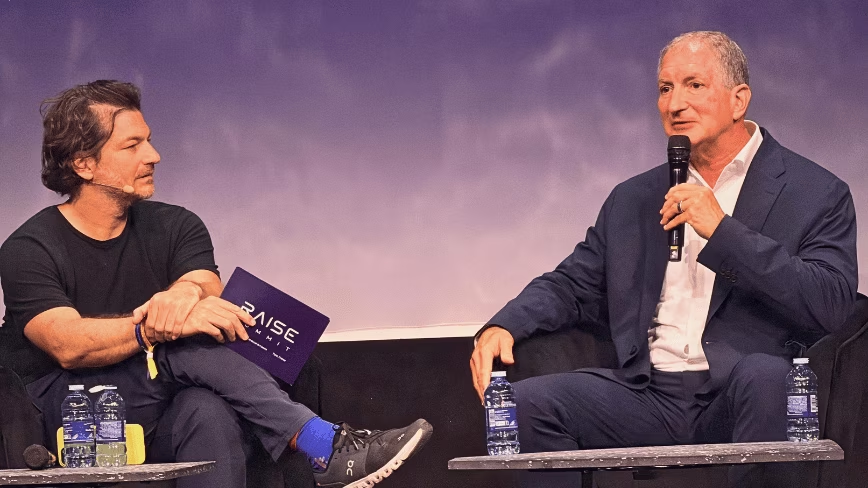
On stage at the RAISE Summit in Paris, the interviewer put it bluntly to Mark Papermaster. He should have bought AMD shares six months ago, he joked, back when they traded near $200. They now sit above $500. AMD is no longer the plucky underdog chasing Intel on CPUs and Nvidia on GPUs. Its market value is nearing a trillion dollars, up more than 140% in a year.
So what did the market suddenly see? Papermaster’s answer is that AMD laid the groundwork years ago. It shipped its first leadership server CPU in 2017 and has kept an annual cadence since. What changed recently is how AI runs.
Why agents need CPUs, not just GPUs
The popular story of the AI boom is a GPU story. Papermaster wants to widen it. When you run agentic applications, he argues, you lean harder on the CPU, not less. “You’re actually using more and more CPU,” he said. One figure he cited pegs it at roughly four times the CPU work to run what today’s agents do.
The reason is orchestration. A single agent is easy. A real workflow runs many agents at once, spins up sub-agents for specific skills, and juggles a growing pile of context. That coordination and reasoning layer runs on the CPU, before the heavy matrix maths lands on the GPU. Agentic AI, in other words, feeds both.
Papermaster has watched this play out inside AMD. The company now designs its own chips with AI help. Tasks that once took many months have dropped to weeks or days. The productivity gains, he said, have jumped from the 10% range to something far larger in the past six months.
A career spent at the inflection points
Papermaster is a useful narrator for a shift like this. He built hardware through the PC era, spent years at IBM, and worked with Steve Jobs at Apple on the iPhone and the iPad. He lived through cloud. Now it is AI.
His pitch for why this moment moves faster is simple. The PC and the internet brought information to everyone. Mobile put it in our pockets. This time, he said, the models can reason, and agentic systems can string those steps together to finish real tasks. That is the leap from looking up answers to actually completing the job.
The bigger change is to AMD’s business. It is no longer just selling silicon. It is selling optimised systems, and it is chasing efficiency across the whole stack.
That is why AMD spent $4.9bn to buy ZT Systems, a builder of hyperscale infrastructure. AMD wanted to tune the full cluster together, CPU, GPU, and networking, rather than a single part in isolation. Papermaster calls it holistic design. “You have to design for the system, all the way through the application stack,” he said. AMD kept the design expertise and sold the manufacturing arm to Sanmina, so it would not compete with its own customers.
The showpiece is Helios, AMD’s rack-scale AI system. It packs 72 of the company’s next Instinct GPUs alongside its server CPUs, and wires them together for large-scale training and inference . Papermaster’s framing is that you have to “feed the beast,” so networking, software, and memory all have to scale in step. The trick, he said, is to hunt down the bottlenecks and clear them, without starving one part to boost another.
AMD’s other long-standing bet is openness. Its ROCm software stack is open. Helios uses an open rack standard that Meta submitted to the Open Compute Project. The networking that ties it together is open too. That is a pointed contrast with the more closed approach of its chief GPU rival .
Does openness slow you down? A closed system can move fast because it controls everything. Papermaster says AMD plays a long game. It ships a new feature with a handful of lead customers, then opens it up and lets the community build on it. “We’ve been committed to open systems, open ecosystems,” he said. The claim is that many partners moving together beats one firm moving alone.
That message lands well in Europe, where buyers increasingly want to avoid lock-in to a single US supplier. AMD’s chips already run some of the region’s biggest machines, from Finland’s LUMI supercomputer to France’s new exascale system. Those open stacks let researchers tailor models to their own languages, Papermaster noted, and keep control of their own sovereign infrastructure .
He also had praise for Brussels, whose energy limits and push for open systems were a theme all week. Early drafts of the EU’s AI rules, he said, seemed to favour a single vendor. Later revisions, in his reading, now encourage diversity and choice. AMD is targeting European customers who want to build open and sovereign systems, and he said it will keep doubling down on the region.
Papermaster stayed coy about specifics, with AMD’s Advancing AI event only two weeks away in San Francisco. He promised the covers would come off Helios there, on 22 and 23 July. He also teased next-generation parts that use TSMC’s 2nm process.
Underneath the roadmap, he kept returning to culture. AMD is now 33,000 people, yet Papermaster insists it has not lost the scrappy, underdog streak from its near-bankruptcy years. AMD has trained everyone in sales on AI, and they write their own agents. The instruction to staff, he said, is to think like an AI-native startup.
For a company whose market value has just multiplied, that is a telling thing to still be worried about.
With expertise in digital marketing, product management, and branding & identity, Ana Maria Constantin develops strategies that resonate (show all) With expertise in digital marketing, product management, and branding & identity, Ana Maria Constantin develops strategies that resonate with our target audience in the software/SaaS industry. Collaboration and teamwork are paramount to her, as she loves empowering her colleagues to achieve outstanding results and unlock their full potential.