
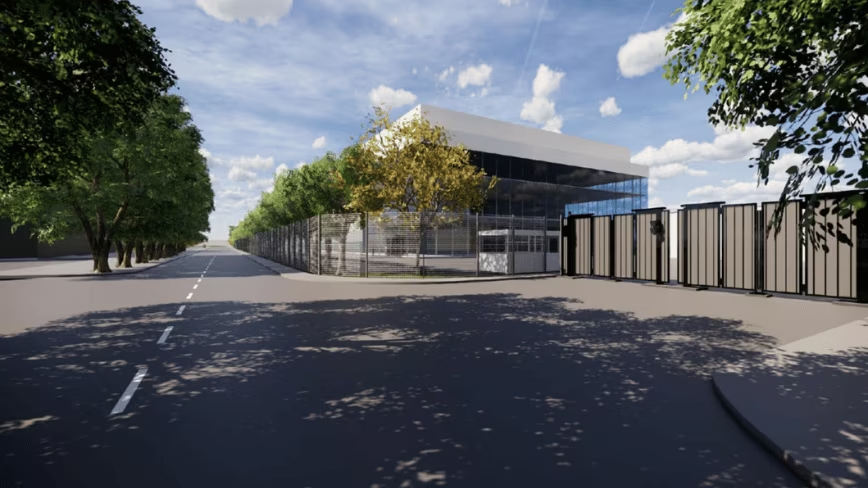
Nscale’s £2bn data centre in Essex has planning permission, an Nvidia backing, and Microsoft as anchor tenant. What it does not have is power, after the National Grid said it could not connect the site in time. The company is now hunting for its own electricity, and it is not alone.
Britain wants to be an AI superpower. One of its flagship data centres cannot get the electricity to switch on. Nscale’s £2bn Essex site has the money, the planning permission, and a grid connection, but no power arriving in time.
Nscale has the cash, the site, and the customer. What it does not have is a plug.
The British AI firm, backed by Nvidia, is building a £2bn data centre at Loughton in Essex, with Microsoft signed up as its anchor tenant. It won planning permission and a 90-megawatt grid connection. Then it learned the power would not arrive in time to open the site next year, Sifted reported .
So the company is now shopping for its own electricity. It is looking at on-site generation, including reported talks with a California fuel-cell maker, rather than waiting on the National Grid. “We remain fully committed to the Loughton project,” a spokesperson said.
Nscale’s problem is not really Nscale’s. It is Britain’s.
Grid-connection times have become the single biggest brake on new data centres. Some UK projects face waits stretching close to a decade for enough power. One estimate found more than a quarter of data-centre capacity slipped in 2025 alone.
The workaround is increasingly to go off-grid. More than 100 UK projects are now weighing gas generation while they wait, according to industry data. That is an awkward answer for a government trying to electrify the economy and clean up its power at the same time.
The politics are uncomfortable. Sir Keir Starmer’s government has made data centres a pillar of its growth plan and named them critical national infrastructure. The grid has not kept pace.
“Britain’s dreams of data centre sovereignty will disappear if we don’t get a grip on the grid,” warned Taco Engelaar of the infrastructure firm Neara. One forecaster now expects the country to miss its 2030 clean-power target, reaching about 83% rather than 95%.
Nscale itself is not short of confidence, cash, or momentum. It grew its headcount 121% in the first half of 2026, one of Europe’s fastest-growing scaleups, and it raised a $900m credit facility only weeks ago. The bottleneck is physical, not financial.
The Essex delay is one instance of a fight playing out across the West. New York just became the first US state to freeze new data centres. Scotland’s governing party wants its own moratorium . In the US, the boom has set off the largest gas-plant building spree in history. Researchers warn Europe’s sovereign-AI plans could stall on the same limits.
The lesson is simple and unwelcome. AI is sold as software, but it runs on electricity. And electricity, unlike capital, cannot be raised in an afternoon.
Alina Maria Stan builds connections that people actually feel. As co-founder and COO of Tekpon, she turns product intuition into real moment (show all) Alina Maria Stan builds connections that people actually feel. As co-founder and COO of Tekpon, she turns product intuition into real moments of discovery, shaping how teams find and adopt SaaS every day. Since 2020, she has led Tekpon’s brand voice, media strategy, and growth plays with a clear focus on human outcomes behind every metric. Before Tekpon, Alina followed curiosity across industries and countries. She was CEO of King Casino Bonus and led affiliate and brand strategy at Extremoo Media and Fable Media in Denmark, where she learned how to build partnerships that last. Early on, she sharpened her CRM and pricing instincts at K.H. ApS, always asking why customers choose what they choose. Her approach is rooted in more than a decade of international experience and two master’s degrees, one in Sustainable Consumption from the Technical University of Munich and one in Consumer Affairs Management from Aarhus University.