
Electronic Arts has launched EA Advertising, a platform that enables brands to buy dynamic, real-time placements inside its sports games, from stadium signage to branded in-game challenges, as the company's $55 billion acquisition by a Saudi-led consortium approaches its June 30 closing deadline
EA launches EA Advertising, a platform for brands to buy real-time ad placements inside its games, reaching 120M monthly players.
Electronic Arts has launched EA Advertising , a platform that lets brands buy dynamic, real-time ad placements inside the company’s sports games. The system delivers ads through stadium signage, digital ad boards, scoreboards, and broadcast-style overlays across titles including Madden NFL, EA SPORTS FC, and EA SPORTS College Football. EA says its games reached more than 120 million monthly players during fiscal year 2026, though those figures come from the company’s own reporting and have not been independently verified.
The platform is built on a proprietary ad server and software development kit designed specifically for EA’s Frostbite engine. It offers what EA describes as privacy-safe targeting and measurement, with campaign verification provided by Integral Ad Science. Brands can also buy into the EA SPORTS Partner Program, which goes beyond standard ad units to include in-game challenges, branded content, and reward-driven objectives woven into gameplay.
Several major brands have already signed on. Visa is partnering with EA SPORTS FC and College Football for what EA calls “ immersive, participatory experiences. ” Red Bull ran branded in-game objectives and team kits in EA SPORTS FC that EA says drove more than 128 million matches played and 1.2 million objectives completed. Mountain Dew built an entire playable team experience in College Football 26 called DEW University, complete with a custom stadium, mascot, and reward ecosystem.
“ Players come to EA’s games and live experiences every day to play, watch, create and connect, ” David Tinson, EA’s president and chief experiences officer, said in a statement. “ That gives brands a meaningful opportunity to show up in ways that add value and respect the player experience. ” EA also cited Lowe’s, Xfinity, and Peacock as existing partners.
EA has tried this before, and it has not always gone well. In 2020, the company inserted full-screen advertisements for the Amazon television series The Boys into UFC 4, a game that cost $60 at retail. The backlash was severe enough that EA disabled the ads within days and issued an apology. As recently as 2024, EA was publicly discussing plans to expand in-game advertising across its sports titles, according to Kotaku, but the formal launch of a dedicated advertising platform with its own ad server and brand partnership programme is new.
The timing is difficult to separate from EA’s ownership change. In September 2025, EA agreed to be acquired by a consortium of Saudi Arabia’s Public Investment Fund, Silver Lake, and Affinity Partners, the Miami-based investment firm founded by Jared Kushner, in an all-cash deal valuing the company at approximately $55 billion. EA shareholders approved the transaction in December 2025, and the deal’s long-stop date is June 30, 2026. The acquisition has not yet closed and remains subject to regulatory approval.
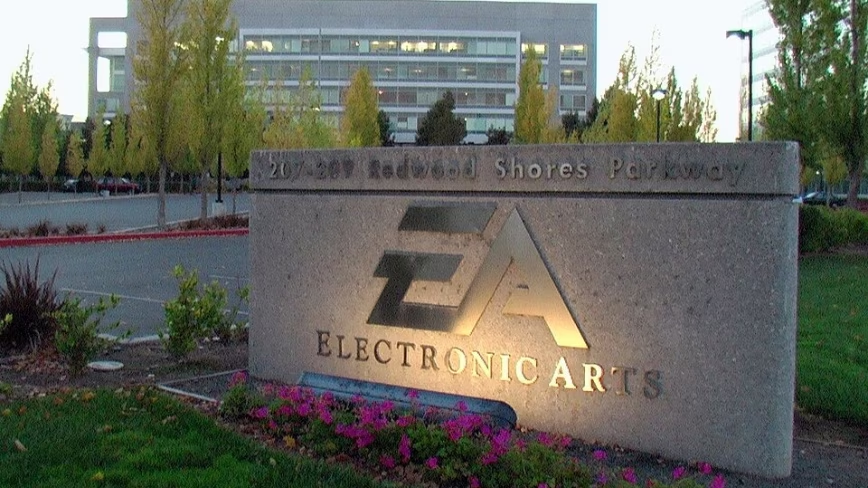
The deal prompted protests. In May 2026, gamers and developers demonstrated outside EA’s Redwood City headquarters, with more than 70,000 petition signatures opposing the acquisition. Demonstrators dressed as Sims characters carried signs reading “ devs and players over investors. ” The concern, shared across gaming media, is that private ownership backed by sovereign wealth will prioritise revenue extraction over the player experience.
EA Advertising does not directly address that concern. Kotaku noted that EA’s press release made no mention of using advertising revenue to offset game prices or reduce the cost of in-game items. Players who pay $70 for a game will see the same brand integrations as those on free-to-play platforms, with no apparent discount or opt-out. EA frames the ads as enhancements, but the question of whether players agree is an open one given the UFC 4 precedent.
The broader context is a rapidly expanding digital advertising market searching for new surfaces. The in-game advertising market is projected to reach $20.7 billion by 2030, growing at a compound annual rate of 13.5%, according to market research estimates. EA’s pitch to advertisers is scale: fans play the equivalent of 23,000 NFL seasons every day in Madden and complete more than one billion matches each month in EA SPORTS FC, per the company’s own figures.
BioWare veteran Mark Darrah, the Dragon Age series producer, offered an unsolicited endorsement of the model earlier this month. Darrah said more studios should consider product placement as an alternative to microtransactions, citing the live-action Smurfs movie as an example of a production that paid for itself entirely through brand deals. The argument is that advertising could fund game development without nickel-and-diming players through loot boxes and season passes.
That argument assumes the advertising replaces existing monetisation rather than stacking on top of it. EA’s sports titles already generate substantial revenue from Ultimate Team card packs and other microtransactions. EA set an $8 billion annual sales record in fiscal 2026. The question facing all digital advertising platforms is whether the pursuit of ad revenue changes the product in ways users did not agree to when they bought it. EA Advertising answers that question for 120 million players, whether they were asked or not.
Technology enthusiast and intern at The Next Web, contributing to research-backed content and investigating new technologies and global even (show all) Technology enthusiast and intern at The Next Web, contributing to research-backed content and investigating new technologies and global events. Interested in business and how the narrative and perception of technology is shaped.