
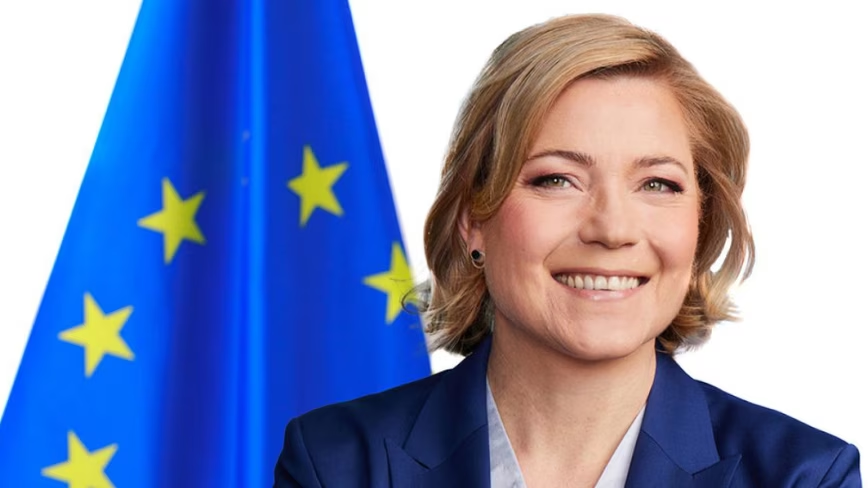
A video call between Henna Virkkunen and Apple’s outgoing chief produced warm words and little else, with the Siri AI standoff still unresolved.
Apple chief executive Tim Cook and the European Union’s technology chief spoke by video call on Monday, and both sides came away describing the exchange as “constructive”. That word is doing a lot of work.
Executive Vice-President Henna Virkkunen, who oversees the bloc’s digital rulebook, held the meeting with Cook on 30 June. An EU spokesperson said the two had a “constructive exchange on topics of common interest, on which the work continues”.
Neither side detailed what was agreed, and the language suggests very little was.
The subject that brought them to the same screen is Siri AI, Apple’s rebuilt voice assistant, and whether it can launch in Europe without breaching the Digital Markets Act . Apple has already confirmed the feature will not ship on iPhone or iPad in the EU when iOS 27 and iPadOS 27 arrive later this year.
The latest rumblings from the EU tech scene, a story from our wise ol' founder Boris, and some questionable AI art. It's free, every week, in your inbox. Sign up now!
That decision, first reported in June, left European users without the assistant on the two devices they use most.
Apple frames the delay as the Commission’s doing. It says regulators rejected every proposal it put forward over several months to bring Siri AI to Europe while safely supporting rival assistants.
The Commission tells the story differently, arguing Apple has been unable to build interoperability that meets the bloc’s privacy and security standards.
Both framings can be true at once, which is part of why the deadlock has proved so hard to break.
At the heart of the dispute is how far the DMA’s interoperability rules reach. Apple argues the Commission’s reading would force it to hand any third-party assistant the same deep access Siri AI enjoys, including the ability to read and send messages, make purchases, and act across installed apps.
The company says stripping out those permissions for rivals would leave users exposed, and that the Commission has not accepted its safeguards. Brussels sees that access as exactly the point of a law designed to prise open gatekeeper platforms .
The restriction applies only to iOS and iPadOS, the two systems the DMA has formally designated. EU users will still get Siri AI on macOS 27, visionOS 27, and watchOS 27. Monday’s call did not change that.
Apple has not committed to a timeline for bringing the assistant to European iPhones, and the Commission has not signalled any softening of its position. The meeting, on the public record at least, produced an agreement to keep talking.
The timing carries its own weight. Cook is preparing to step down as Apple’s chief executive, with hardware boss John Ternus expected to take over, and much of Cook’s remaining value to the company has centred on his role as its senior government liaison.
A cordial sign-off with Brussels fits that brief. The dispute also arrives as the Commission tightens its grip more broadly, having moved to force Google to open Android to rival assistants under the same law. Apple is not being singled out, even if it feels that way in Cupertino.
The wider relationship is anything but warm. The Commission has fined Apple €500m over App Store steering rules, and the company remains under scrutiny across several DMA workstreams.
Against that backdrop, a single video call reads less as a breakthrough than as both sides keeping a difficult channel open.
What Monday did not deliver was any substance a European iPhone owner could use. Siri AI remains unavailable on the devices most people in the bloc actually carry, and the two parties have committed only to further conversation.
Whether the next round produces more than an adjective remains to be seen. For now, the assistant stays on the far side of a regulatory line neither Apple nor Brussels seems ready to redraw, and the “constructive” label sits over a standoff that has not moved.
I am the Editor in Chief for TNW, covering technology not as a parade of launches and valuations, but as a system of influence, persuasion, (show all) I am the Editor in Chief for TNW, covering technology not as a parade of launches and valuations, but as a system of influence, persuasion, and change. I write about startups, venture capital, digital policy, and Europe ecosystem, with an eye on the larger story beneath them: who gets to build the future, who profits from it, and how Europe is learning to speak in a louder voice of its own. Before moving into senior editorial leadership, I've built my career for over +10 years across journalism, storytelling, content strategy, SEO, and digital publishing, with experience in SaaS, hospitality, art, and culture.