
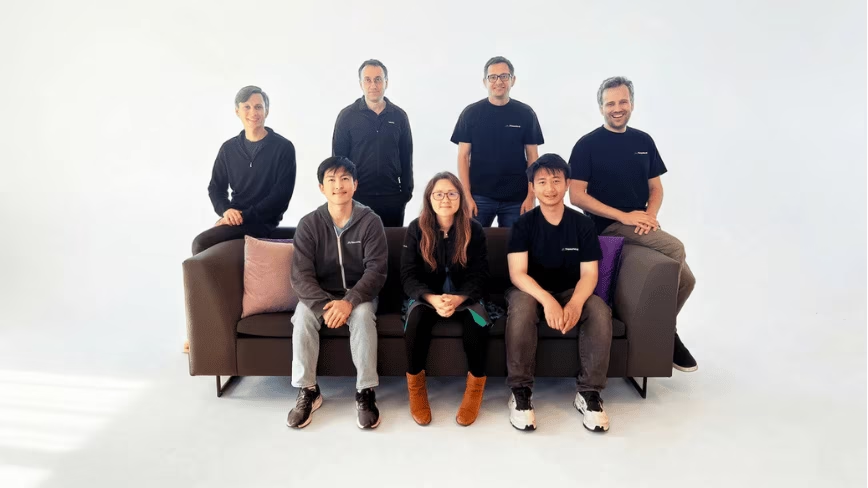
Fireworks has raised a $1.5bn Series D at a $17.5bn valuation, betting that every company will build its own specialized intelligence rather than rent a model from a big lab.
The AI economy has run on a simple habit: rent a model from a big lab. Fireworks just raised $1.5bn to argue the opposite, that every company will build intelligence of its own.
The Series D values the San Mateo startup at $17.5bn, it said . Atreides Management, Index Ventures, and TCV led the round. Nvidia, an existing backer, joined again.
“Fireworks has assembled one of the most elite and technical teams in AI,” said Gavin Baker, Atreides’ managing partner, in the funding announcement.
Fireworks runs open models for other companies, then helps them tune those models on their own data. It calls the result “specialized intelligence”: a model shaped by the knowledge only one business holds.
The latest rumblings from the EU tech scene, a story from our wise ol' founder Boris, and some questionable AI art. It's free, every week, in your inbox. Sign up now!
The thesis is landing. Revenue has passed $1bn on an annualised basis, up fivefold in a year, Index Ventures said . The platform now serves more than 40 trillion tokens a day, and 95% of them run on specialized models.
That token figure is startling. Fireworks handles more requests each day than Google or OpenAI report serving developers, on CNBC’s numbers. It is a fraction of their size in revenue, yet it moves more traffic.
The demand tracks a wider shift. As open models close on the best closed ones, the AI race has tilted from the biggest model to the cheapest capable one. Fireworks says its option runs at a fifth to a tenth of the cost .
Chief executive Lin Qiao framed it as a choice when she announced the round. “In one [path], intelligence belongs to a few big labs, and everyone else rents it,” she said. “We are building towards the second.”
She is not alone. Microsoft’s Satya Nadella argues a firm should use a model without handing over the knowledge that makes it unique. Palantir’s Alex Karp says clients want to “own the means of production.”
Former Meta engineers behind PyTorch built Fireworks in 2022. It competes with Together AI and Baseten on inference, and increasingly with neocloud rivals on training.
Its biggest risk is concentration. Cursor once supplied about half its revenue, though Qiao says the base is now broader. She plans to grow headcount from 200 to 600 by year-end. “This is the year when we’ll really hit the gas,” she told CNBC.
Cristian Dina is the CRO at The Next Web. He has interviewed 300+ industry leaders and authored the book King of Networking, establishing hi (show all) Cristian Dina is the CRO at The Next Web. He has interviewed 300+ industry leaders and authored the book King of Networking, establishing himself as one of the most connected and respected voices in the ecosystem. At just 23 years old, Cristian was included in the Forbes 30 Under 30 2025 list, representing a new generation of tech builders, bold thinkers who move fast, build with purpose, and create real impact.