
This article was published on January 19, 2024
The crew will spend 14 days in orbit, conducting more than 30 microgravity experiments
A private space mission launched four European astronauts to the International Space Station on Thursday, in a milestone for a region desperate to boost its space credentials following a series of setbacks.
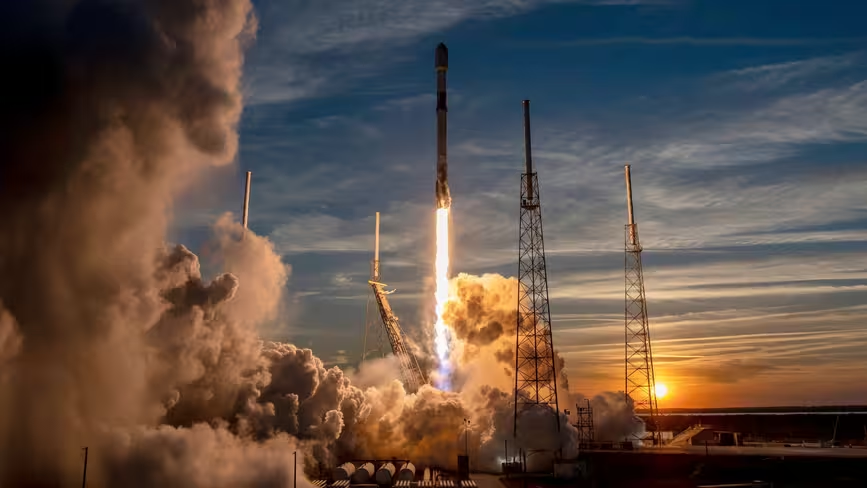
A SpaceX Falcon 9 rocket blasted the astronauts into orbit, launching from NASA’s Kennedy Space Center in Florida. The spacecraft is expected to arrive at the ISS in the early hours of January 20.
Spanish astronaut Michael López-Alegría will lead the space crew. Also on board is Walter Villadei of the Italian Air Force, Alper Gezeravcı from Turkey, and Marcus Wandt of Sweden. Gezeravcı is Turkey’s first-ever astronaut.
Organised by Axiom Space, the mission is the American company’s third crewed venture into low Earth orbit. The startup is also developing its own space station and building space suits for NASA.
The launch is part of a new era where countries no longer have to build their own rockets and spacecraft to undertake space missions. Now they can simply purchase rides from a commercial company, almost like buying a plane ticket.
Axiom’s launch comes at a pivotal moment for Europe’s space industry, which has suffered a number of setbacks in recent years. With the Ariane 5 rocket officially decommissioned and Italy’s Vega C rocket grounded following launch failure in 2022, Europe is currently without independent access to space satellites.
This year looks to be more promising though. The Ariane 6 rocket, Ariane 5’s successor, is expected to blast off this summer, while the Vega-C rocket is set to lift off towards the end of the year. The ESA also recently announced a new budget of €7.8bn — the largest amount ever dedicated to European space exploration.
“This year will look much better,” Josef Aschbacher, the director general of the European Space Agency, said last week at an annual press briefing .
Siôn is a freelance science and technology reporter, specialising in climate and energy. From nuclear fusion breakthroughs to electric vehic (show all) Siôn is a freelance science and technology reporter, specialising in climate and energy. From nuclear fusion breakthroughs to electric vehicles, he's happiest sourcing a scoop, investigating the impact of emerging technologies, and even putting them to the test. He has five years of journalism experience and holds a dual degree in media and environmental science from the University of Cape Town, South Africa. When he's not writing, you can probably find Siôn out hiking, surfing, playing the drums or catering to his moderate caffeine addiction. You can contact him at: sion.geschwindt [at] protonmail [dot] com