
This article was published on June 28, 2023
But don't book your tickets just yet
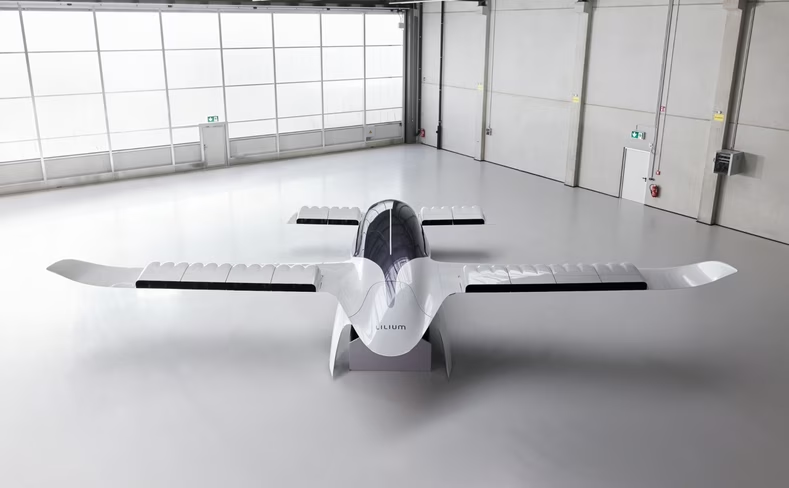
Flying cars have captured the public imagination for decades, but have yet to enter the mainstream. However, with investors pouring cash into the sector, could the 2020s be the decade when sci-fi vision becomes reality? German startup Lilium certainly hopes so.
The startup announced this week that the design of its all-electric vertical take-off and landing (eVTOL) jet has been approved by the US Federal Aviation Administration ( FAA ). Lilium’s primary airworthiness authority, the European Union Aviation Safety Agency (EASA), issued its approval — known as a ‘certification basis’ — for the jet in 2020.
Lilium, which has raised a whopping $1bn to date since its founding in 2015, has developed an eVTOL jet — which differs from the helicopter-style craft developed by most eVTOL startups — that it hopes will take passengers faster and further than the competition. It aims to begin commercial flights from late 2025.
But the startup has little control over this timeline, regulators do. Regulators oversee every component of these machines, from the engines to software, and make the final call of whether an aircraft meets all the stringent requirements for commercial flight.
The latest rumblings from the EU tech scene, a story from our wise ol' founder Boris, and some questionable AI art. It's free, every week, in your inbox. Sign up now!
Achieving certification basis is the first step on this complicated, and expensive, journey. Essentially it means that both the FAA and the EASA have approved Lilium’s jet design as commercially viable. However, there are still three more steps to go before the authorities issue a type certificate — the golden ticket to the skies. The certification process can cost hundreds of millions of dollars.
Despite the hurdles ahead, Lilium CEO Klaus Roewe is confident. “Receiving the FAA G-1 demonstrates the Lilium Jet’s path to global acceptance by aerospace regulators and the expected start of global operations in late 2025 for the revolutionary Lilium Jet,” he said.
Whether the startup can secure enough of a runway to pay for certification, while growing its team and developing its product, is anyone’s guess. But if the track record of other eVTOL ventures is anything to go by, I would take Lilium’s 2025 target with a pinch of salt.
Siôn is a freelance science and technology reporter, specialising in climate and energy. From nuclear fusion breakthroughs to electric vehic (show all) Siôn is a freelance science and technology reporter, specialising in climate and energy. From nuclear fusion breakthroughs to electric vehicles, he's happiest sourcing a scoop, investigating the impact of emerging technologies, and even putting them to the test. He has five years of journalism experience and holds a dual degree in media and environmental science from the University of Cape Town, South Africa. When he's not writing, you can probably find Siôn out hiking, surfing, playing the drums or catering to his moderate caffeine addiction. You can contact him at: sion.geschwindt [at] protonmail [dot] com