
This article was published on February 28, 2025
A spaceplane with capacity for 1-ton payloads has been commissioned for completion by 2028
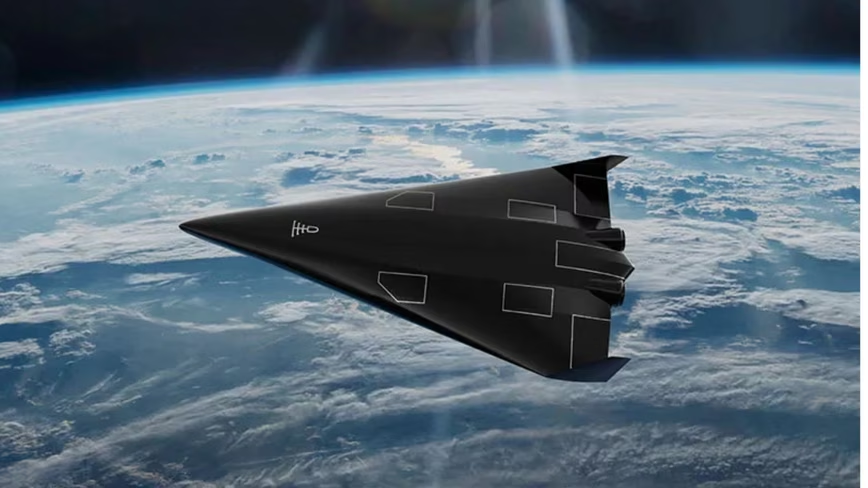
Germany’s armed forces have commissioned Bremen-based startup Polaris to develop a two-stage, fully reusable hypersonic space plane — and given the team just three years to build it.
Dubbed Aurora, the 28-metre-long aircraft will be part rocket, part plane — designed to take off and land on a runway but also blast through the atmosphere and place payloads up to 1-ton in low-Earth orbit .
Under the contract, the startup will design, build, and flight test the spaceplane. The aircraft will serve as a testbed for hypersonic flight and defence research. It could be used as a small satellite carrier if fitted with a non-reusable upper stage, Polaris said.
Polaris was founded in 2019 by Alexander Kopp as a spin-off from the German Aerospace Center (DLR). It builds upon over three decades of German and European spaceplane research.
The startup has already built three demonstrators of its Aurora spaceplane. The first, Mira I, crashed shortly after its inaugural flight. But the next two iterations — Mira-II and Mira-III — had better luck. These 5-meter-long vehicles, each weighing 240kg, have completed over 100 successful test flights since they first launched in September last year.
The latest rumblings from the EU tech scene, a story from our wise ol' founder Boris, and some questionable AI art. It's free, every week, in your inbox. Sign up now!
The Mira prototype series relies on jet engines for takeoff, cruise, and landing, while incorporating an aerospike rocket engine for high-speed propulsion tests. First conceived in the 1960s, aerospike engines adjust to air pressure changes at all altitudes, making them more efficient than traditional designs.
However, aerospikes never entered the mainstream because they are hard to cool and difficult to build. Polaris’ work on advanced cooling technologies and materials may just overcome past engineering challenges.
Polaris made history in October last year when it conducted the first-ever flight powered by an aerospike engine. The AS-1 engine was ignited in flight for three seconds aboard the Mira-II over the Baltic Sea, delivering a thrust of 900 Newtons and accelerating the 229kg vehicle to 864km/h.
The Mira’s future big sister Aurora, however, will be designed to reach hypersonic speeds above Mach 5 (over 6,125km/h) and beyond.
Spaceplanes like Aurora could prove a more cost-effective way to access space than rockets because they can take off from a conventional runway and be reused time and time again — just like a plane, but with more juice.
Polaris’ announcement comes days after Germany’s incoming Chancellor Friedrich Merz cast doubts over whether NATO would remain in its “current form,” urging Europe to increase defence spending .
Siôn is a freelance science and technology reporter, specialising in climate and energy. From nuclear fusion breakthroughs to electric vehic (show all) Siôn is a freelance science and technology reporter, specialising in climate and energy. From nuclear fusion breakthroughs to electric vehicles, he's happiest sourcing a scoop, investigating the impact of emerging technologies, and even putting them to the test. He has five years of journalism experience and holds a dual degree in media and environmental science from the University of Cape Town, South Africa. When he's not writing, you can probably find Siôn out hiking, surfing, playing the drums or catering to his moderate caffeine addiction. You can contact him at: sion.geschwindt [at] protonmail [dot] com