
The Central Asian energy producer wants to be a regional AI hub. The accords with US startup Firebird, with Nvidia's support, could bring up to $10bn, though most of that is still a memorandum, not money in the ground.
The Kazakhstan AI deal is signed. Kazakhstan has agreed a set of accords with Firebird, a US startup backed by Nvidia, to build artificial-intelligence data centres that could draw as much as $10bn in investment, as the oil-and-gas producer tries to reinvent itself as a computing hub for the region.
The centrepiece is Data Center Valley, planned for Ekibastuz, an energy hub in the northeast. Its first phase is set at about $5bn, including $1bn from state-owned operator Kazakhtelecom, and aims to bring a 125-megawatt site online commercially in 2027.
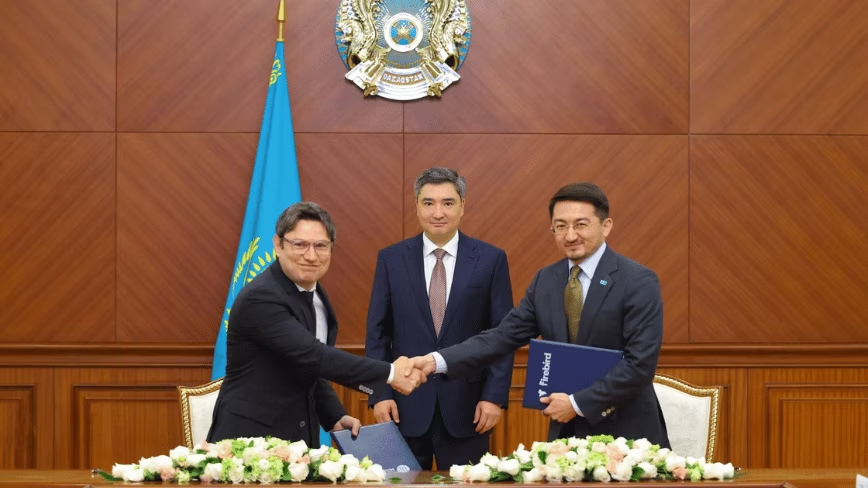
The accords were signed in Astana by Prime Minister Olzhas Bektenov, Nvidia’s Rev Lebaredian, and Firebird co-founders Razmig Hovaghimian and Alexander Yesayan.
What’s actually in the Kazakhstan AI deal
The headline number deserves a close read. The “$10bn” is a potential total across several agreements, not a single committed cheque. The core documents are a strategic cooperation framework between Kazakhstan’s AI ministry and Firebird, and a binding term sheet between Kazakhtelecom and Firebird for the data centres.
A framework sets intent; the firmer piece is the $5bn first phase, and even that depends on financing, power and chips landing on schedule.
The ambition is big. Officials say the build will host at least 300 megawatts of computing, scaling toward a gigawatt, with as many as 100,000 Nvidia GPUs, including its newest GB300 and Vera Rubin chips, and could earn $3bn a year in exports. Those are targets, not installed kit.
Nvidia’s role here is supplier and supporter, not financier, but its chips are the scarce resource every hub wants, so a vice-president flying in to sign matters.
The deal is part of a wider scramble. Governments from the Gulf to Southeast Asia are striking AI-infrastructure pacts to avoid being left dependent on a handful of US and Chinese clouds, and the same $10bn-scale numbers keep recurring, as they did in the US-backed Philippines hub plan.
Energy-rich, capital-light states are offering power and ground in exchange for the chips and know-how they lack.
The risk is that announcements outrun concrete. Memoranda are easy; financed, powered, chip-stocked data centres are hard, and many grand regional-hub plans stall between the signing and the build. Firebird’s pitch is that it moves fast: it says it stood up a flagship AI Factory in Armenia in about six months, due online in July.
Whether Data Center Valley becomes infrastructure or stays a press release will depend on what gets funded after the cameras leave.
Alina Maria Stan builds connections that people actually feel. As co-founder and COO of Tekpon, she turns product intuition into real moment (show all) Alina Maria Stan builds connections that people actually feel. As co-founder and COO of Tekpon, she turns product intuition into real moments of discovery, shaping how teams find and adopt SaaS every day. Since 2020, she has led Tekpon’s brand voice, media strategy, and growth plays with a clear focus on human outcomes behind every metric. Before Tekpon, Alina followed curiosity across industries and countries. She was CEO of King Casino Bonus and led affiliate and brand strategy at Extremoo Media and Fable Media in Denmark, where she learned how to build partnerships that last. Early on, she sharpened her CRM and pricing instincts at K.H. ApS, always asking why customers choose what they choose. Her approach is rooted in more than a decade of international experience and two master’s degrees, one in Sustainable Consumption from the Technical University of Munich and one in Consumer Affairs Management from Aarhus University.