
Ollama, the tool that made running open-source AI models on your own laptop a one-line command, has raised $65M. The bet: open models will do most of the world's AI work, and developers will want to own them.
Ollama has raised a $65M Series B led by Theory Ventures. Benchmark, 8VC, Y Combinator and others joined. The round takes the company’s total funding to $88M, three years after it launched, and Ollama set out the plan in a blog post on Thursday.
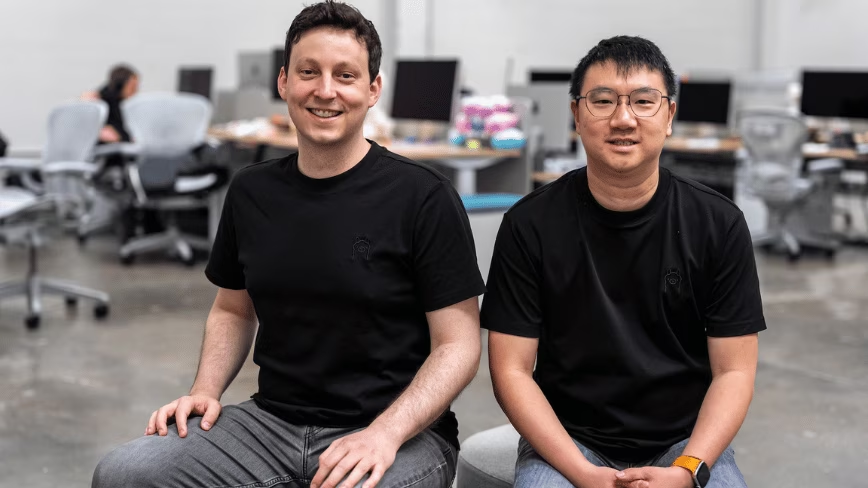
Founder and chief executive Jeff Morgan gave the details to TechCrunch , which broke the raise.
The pitch is simple. Ollama lets a developer download an open-weight model and run it locally in a single command. If a laptop cannot handle a bigger model, Ollama’s cloud runs it instead, with the same setup. It bills for that cloud by GPU time, not per token.
The founders have done this before. Morgan and co-founder Michael Chiang built Kitematic, which Docker bought in 2015. Their work there became Docker Desktop, which more than ten million developers now use. Ollama is the same move for AI. It hides the messy setup and lets people just run the thing.
The traction is hard to argue with. Ollama says 8.9 million developers now use it each month, up from half that in January. It adds close to a million installs a week. It sits inside 85% of the Fortune 500, including government, healthcare and finance. The team is 14 people.
The money rides on a shift from closed AI models to open ones. “Open-weight models will generate the supermajority of tokens within the next 18 to 24 months,” said Peter Fenton, the Benchmark partner who led Ollama’s earlier round and sits on its board. Theory’s Tomasz Tunguz frames Ollama as the platform layer that everything else plugs into, a valuable spot to hold.
Fenton is careful to call it a shift, not a war. Open versus closed is “not an either/or,” he told TechCrunch. But firms with heavy inference bills have a strong reason to move to open models. They can then lean on closed ones like Anthropic only as needed . Morgan says the turning point came around January, when open models got good enough to handle agentic work like coding.
Ollama’s cloud hosts the heavyweight open models: Nemotron , GLM, DeepSeek, Kimi and MiniMax . It is a distribution partner for those labs, and for chipmakers Nvidia, AMD, Intel and Qualcomm. That deal gets its users new models on day one. Ollama is one of a wave of open-source projects now turning into venture-backed companies.
The growth has a critic camp. About a year ago, some fans accused Ollama of letting its paid cloud pull focus from the free project. They filed the gripe under the “enshittification” of developer tools. Morgan and Fenton push back. The free desktop app has not changed, they say, and the cloud simply reaches models too big to run at home.
Ollama is a marker for how fast open models have moved from research toys to production tools. If the cheap, ownable option really does generate most AI tokens, the layer that runs them becomes valuable ground. Ollama got there first, with 14 people and a one-line install.
Cristian Dina is the CRO at The Next Web. He has interviewed 300+ industry leaders and authored the book King of Networking, establishing hi (show all) Cristian Dina is the CRO at The Next Web. He has interviewed 300+ industry leaders and authored the book King of Networking, establishing himself as one of the most connected and respected voices in the ecosystem. At just 23 years old, Cristian was included in the Forbes 30 Under 30 2025 list, representing a new generation of tech builders, bold thinkers who move fast, build with purpose, and create real impact.