
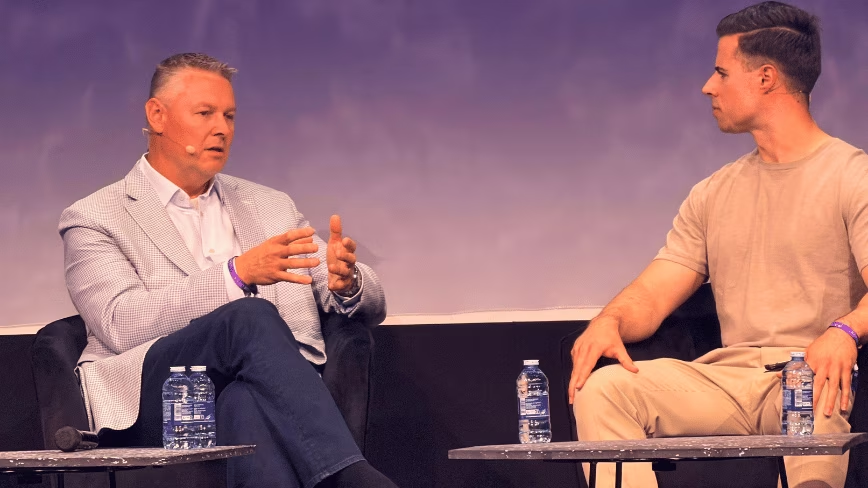
At the RAISE Summit in Paris, Oracle's president of global field operations made a pointed case: the real AI advantage is not the model you buy. It is the private data you already own, and where you choose to keep it.
The pitch for enterprise AI usually starts with the model. Mark Hura, Oracle ‘s president of global field operations, wants to flip that. He spoke on stage at the RAISE Summit in Paris. The companies winning with AI , he argued, are not shopping for an AI stack at all. They are chasing an outcome.
Take a hotel group, he said. It runs property management, guest systems, food and beverage, staff, finance, and supply chains. “They’re not thinking about buying an AI stack,” Hura said. They are asking how to improve the guest experience, get people to book again, and free up their staff. The AI is a means, not the point.
Hura reached for concrete cases. In banking, the draw is speed against fraud. In healthcare, he said, Oracle’s clinical AI drafts a patient summary before the visit, pulls the history, and turns the conversation into notes by voice. It can suggest medicines, follow-ups, and referrals.
The payoff, he argued, is time. Patients get a doctor who is looking at them, not a terminal. Clinicians get hours back, which lets them see more people and eases a high-stress job. In construction and engineering, he claimed AI had cut certain processes by 72 per cent. One customer, he said, saved more than $130,000 a year. In energy, it fuses outage and weather data to predict failures and move crews.
The latest rumblings from the EU tech scene, a story from our wise ol' founder Boris, and some questionable AI art. It's free, every week, in your inbox. Sign up now!
Underneath the examples sat Oracle’s real argument. Frontier models are getting very good, Hura said, so the edge no longer comes from the model. It comes from a company’s own private data, fused into those models. That data, he added, is where the intellectual property lives.
This is a convenient thesis for a firm that has sold databases for five decades. Hura’s point is that Oracle can bring AI to where the data already sits. It does not copy or move the data. That, he says, cuts both cost and the risk of a leak. He framed the mission-critical data locked inside Oracle systems as a strategic advantage, with partner models brought in to work on it.
Hura’s sharpest line was about strategy. Enterprises have piled up complexity over years of acquisitions and half-migrated systems, he said, through nobody’s fault. Bolting AI on from the bottom, and hoping it grows organically, delivers productivity but can miss the goal.
“If you just start at the bottom,” he warned, you get efficiency. But you may miss the industry outcome: a better guest experience, lower hospital readmissions, or less fraud. His advice was to start from the biggest business problem, treat it as a chief-executive decision, and make the result measurable.
For a European audience, Hura leaned on sovereignty . Banks, hospitals, and utilities want their data under their own control, he said, and the definition keeps shifting. Oracle’s answer is one architecture at every size. It runs the giant data centres that train frontier models. It also runs a three or four-rack setup inside a customer’s own building, without losing features.
Hura is, of course, selling. The claim that your data is the advantage, and that it should stay where Oracle already holds it, serves Oracle neatly. But the outcome-first critique lands at a real moment. Plenty of enterprise AI pilots have stalled between demo and deployment. His bet is that the ones tied to a hard business number are the ones that survive.
Cristian Dina is the CRO at The Next Web. He has interviewed 300+ industry leaders and authored the book King of Networking, establishing hi (show all) Cristian Dina is the CRO at The Next Web. He has interviewed 300+ industry leaders and authored the book King of Networking, establishing himself as one of the most connected and respected voices in the ecosystem. At just 23 years old, Cristian was included in the Forbes 30 Under 30 2025 list, representing a new generation of tech builders, bold thinkers who move fast, build with purpose, and create real impact.