
This article was published on March 30, 2025
Isar Aerospace hailed the launch a "great success" — despite it ending in a fireball
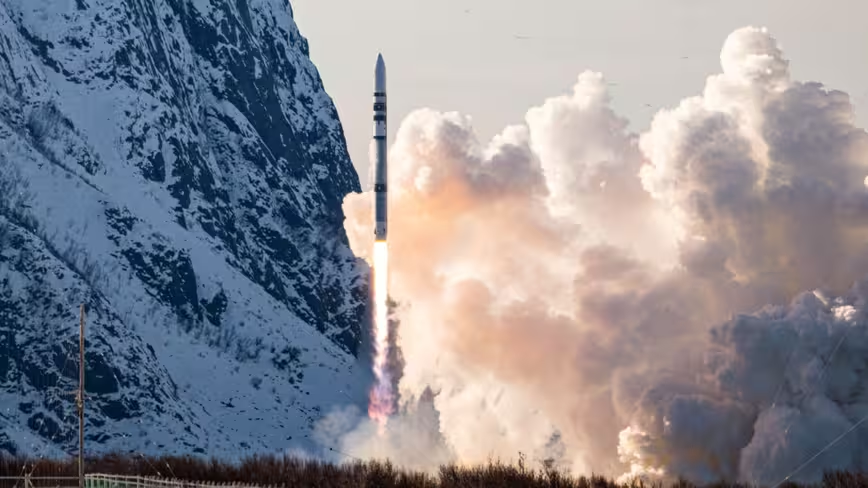
German startup Isar Aerospace launched its Spectrum rocket from Andøya Spaceport in Norway today, marking the first-ever vertical orbital rocket launch in Western Europe.
Spectrum blasted off at 12:30 PM CEST (11:30 BST) but lost control at about 25 seconds into the flight. A video from the launch shows the rocket wobble, pitch over, and then plummet back to the ground, where it collided with the ocean, causing a large explosion. The launchpad remains intact and no one was injured, Isar said.
Drone and pad footage from Isar Aerospace’s Spectrum launch. You can see it avoided the pad when it came down. pic.twitter.com/NePozHqYad
— NSF – NASASpaceflight.com (@NASASpaceflight) March 30, 2025
Despite a quick and abrupt end to Spectrum’s inaugural flight, Isar’s CEO and co-founder Daniel Metzler hailed the launch as a “great success.”
“We had a clean liftoff, 30 seconds of flight, and even got to validate our flight termination system,” Metzler said. “With this result, we feel confident to approach our second flight.”
Spectrum’s first flight carried no payload. Isar Aerospace said the aim of the launch was “to collect as much data and experience as possible.”
The 28-meter (91-foot) Spectrum is a two-stage launch vehicle designed to propel small and medium-sized satellites into orbit.
The company expects to produce as many as 40 rockets per year from its new factory, which is currently under construction outside its headquarters in Munich. Spectrum launch vehicles 2 and 3 are already in production, Isar said.
Spectru m’s in augural flight marks the first-ever ver tical orbital rocket launch i n cont inental E urope outside Russia.
V ir gin Orbit a ttempt ed an orbital la un ch from the UK in 2 0 2 3, but the plan failed. E urope’s other rockets, Aria n e 6 and Vega C, launch from Europe’s main space port in F rench Guiana, South America .
Isar Aerospace is the first private space company to use Andøya Spaceport, which officially opened in 2023. The spaceport, loc ated close to the Arctic Circle , offe rs easy access to polar and su n-sync hronous orbits — i deal for Earth observation and spy satellites.
Isar Aerospace signed a deal in February with the N orwegian Sp ace Ag ency to lau nch its Arctic Ocea n Surve illance (AOS) prog ram satellites until 2028. The com pany l ooks to la unch up to 15 missions per year from And øya, at a cost of aro und €1 0mn per flight.
Opening up orbital launches from Western Europe promises to simplify logistics for European satellite operators by eliminating the need to ship payloads overseas. Access to smaller, cheaper launch vehicles that can place a single satellite in orbit could also offer a more flexible, fast, and precise alternative to ride-sharing.
Then there are the geopolitical considerations. Launching from continental Europe would reduce reliance on foreign launch providers like SpaceX, enhancing sovereign access to space amid growing geopolitical tensions.
Metzler touched on that point in a statement last week: “In today’s geopolitical climate, our first test flight is about much more than a rocket launch.”
Founded in 2018 as a spin-off f rom Techni cal University Munich, Isar Aerospace has secured €400mn to date, making it Europ e’s mo st well- f unded private space company.
While Andøya is Europe’s first continental spaceport, others are underway, the most advanced being the SaxaVord spaceport in the Shetlan d Island s off Scotland.
Rocket Factory Augsburg, a rival to Isar, was m eant to launch from the site last year. Howeve r, the startup suffered a major setback after its rocket exploded during a st atic-fire test , pushing back its in augu ral f light to later this year.
Siôn is a freelance science and technology reporter, specialising in climate and energy. From nuclear fusion breakthroughs to electric vehic (show all) Siôn is a freelance science and technology reporter, specialising in climate and energy. From nuclear fusion breakthroughs to electric vehicles, he's happiest sourcing a scoop, investigating the impact of emerging technologies, and even putting them to the test. He has five years of journalism experience and holds a dual degree in media and environmental science from the University of Cape Town, South Africa. When he's not writing, you can probably find Siôn out hiking, surfing, playing the drums or catering to his moderate caffeine addiction. You can contact him at: sion.geschwindt [at] protonmail [dot] com