
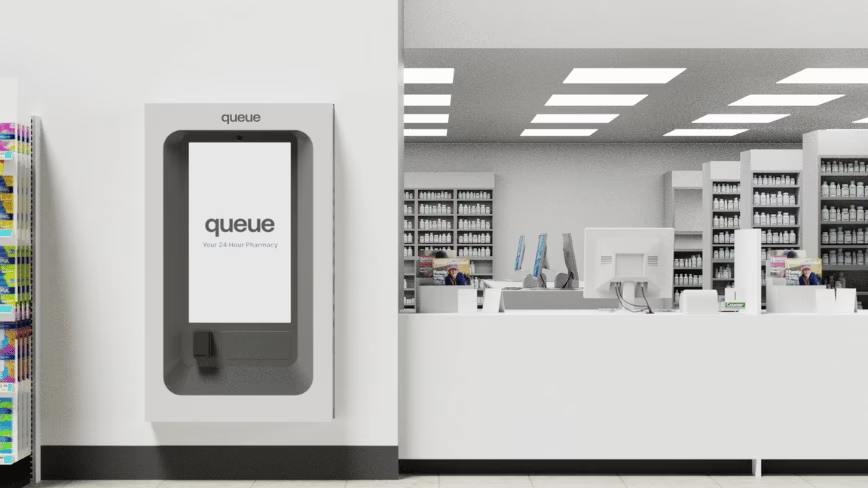
The Silicon Valley startup emerged from stealth with a $12.6M seed led by AlleyCorp and a self-contained machine it calls the world's first fully autonomous robotic pharmacy. The regulators are the catch.
A Silicon Valley startup says it has built a pharmacy with no pharmacist behind the counter. Sealed bottles go in, filled and checked prescriptions come out, in about a minute.
The company, Queue, came out of stealth on Tuesday with a working machine and fresh money. It has raised a $12.6mn seed round led by AlleyCorp, it announced . That follows a $6mn pre-seed from Riot Ventures less than a year ago, and takes the total raised to $18.6mn. Ubiquity Ventures and House Capital also joined.
The product is a self-contained box that Queue calls the world’s first fully autonomous robotic pharmacy. Sealed wholesale bottles go in one end. Filled and verified prescription vials come out the other.
Queue says the process needs zero human involvement, dispenses up to 600 pills a minute, and stocks 250 different medications. It claims the unit cuts the cost to dispense by 96 per cent, and hands a patient their script in 60 seconds or less.
The gap Queue wants to fill is real. The company says one in three US pharmacies has shut down, and that the survivors run their pharmacists into the ground. Large parts of the country now count as pharmacy deserts, where the nearest counter sits miles away.
The pitch is that a machine can take over the mechanical work of counting and bottling pills. That frees pharmacists for the part only they can do, such as counselling patients and catching drug interactions.
Automated dispensing is not new in itself. Hospitals have run pill-picking robots for years, and retail chains have tried kiosk pharmacies. Queue’s twist is to strip the human out of the loop entirely, and to shrink a whole pharmacy into one box that can sit wherever patients are.
The founders bring a track record. Nick Desai has started six companies and previously ran the house-call service Heal. His co-founder Joshua Liu came from Tesla, Waymo, and the delivery-drone firm Zipline. The team is still small, at around 20 people.
Queue lands in the middle of a rush of money into physical machines. Investors who spent years backing pure software now chase robots that do work in the real world. Startups are automating jobs once thought safe, from hair braiding to construction , and into healthcare, where robots now range from companion pets to prescription counters.
Y Combinator has even told founders to build hard tech as software loses its edge. Much of the talent flows out of carmakers and their self-driving arms, the same route ex-Tesla engineers have taken into robotics.
The claims raise an obvious question. In much of the US, state law requires a licensed pharmacist to give the final check before a prescription reaches a patient. Controlled drugs carry tighter federal rules again. A machine that promises zero human involvement will have to convince state pharmacy boards that its checks match a human’s.
Queue frames the pharmacist as freed rather than removed, which may be the point. The robot does the counting. A pharmacist still owns the sign-off, at least on paper.
There is also the gap between a demo and a rollout. Queue has a working unit and a bold name. It has not yet shown the system running across many sites, under real prescription volumes, for months on end. The money buys it the chance to try. Whether a box of robotics can safely stand in for the corner pharmacy is the test that now begins.
Cristian Dina is the CRO at The Next Web. He has interviewed 300+ industry leaders and authored the book King of Networking, establishing hi (show all) Cristian Dina is the CRO at The Next Web. He has interviewed 300+ industry leaders and authored the book King of Networking, establishing himself as one of the most connected and respected voices in the ecosystem. At just 23 years old, Cristian was included in the Forbes 30 Under 30 2025 list, representing a new generation of tech builders, bold thinkers who move fast, build with purpose, and create real impact.