
The Wisconsin startup says it is the first private fusion company to harvest electricity directly from its machine, bypassing the steam turbine. The catch: it is a proof of concept, not net power.
Fusion’s hard problem was making more energy than you put in. The next one is turning that energy into cheap electricity. A Wisconsin startup says it has taken a first step, by lighting a few bulbs straight from its reactor.
The company is Realta Fusion. On 30 June it announced the first demonstration of direct energy conversion by a commercial fusion firm. In an experiment on 19 June, its device drew several amps of current at around 100 volts. That was enough to power a handful of light bulbs, the company said .
Direct energy conversion, or DEC, is the appealing shortcut of fusion. Most reactors, like today’s fission plants, plan to make electricity the old-fashioned way. They use the heat to boil water, spin a turbine, and drive a generator. That process is lossy. DEC skips it and harvests electricity straight from the charged particles that stream out of the reaction.
The prize is efficiency. A steam turbine in a fission plant converts about a third of its energy into electricity. Realta puts DEC at over 90 per cent. Chief executive Kieran Furlong told TechCrunch the gain matters. Every fusion plant has to spend power to run itself. “We can take power from a plasma,” he said. The more a plant can recycle, the sooner it can turn a profit.
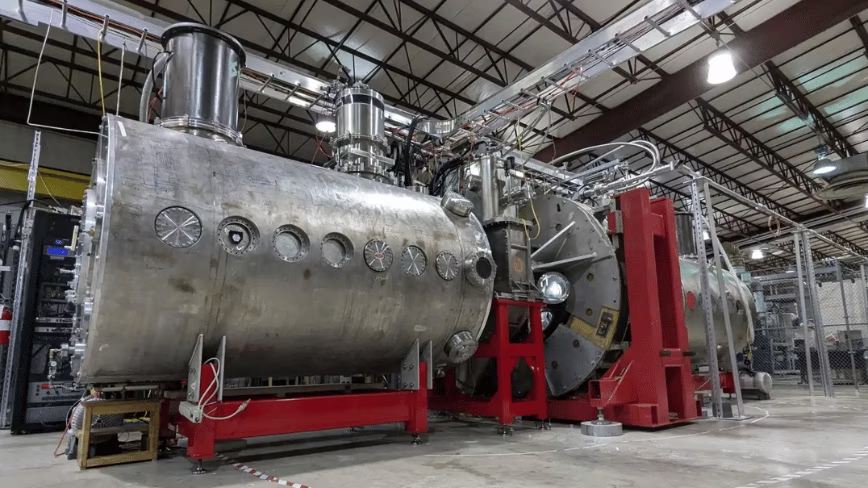
Realta ran the test on WHAM, the experimental machine it operates with the University of Wisconsin-Madison. It bolted a prototype converter onto one end. The converter slows the charged particles down, which builds up a voltage and drives a current. In Realta’s planned first-generation plants, a traditional steam cycle would still do most of the work.
The latest rumblings from the EU tech scene, a story from our wise ol' founder Boris, and some questionable AI art. It's free, every week, in your inbox. Sign up now!
DEC would handle the fifth of the power carried by charged particles. It would also claw back the energy used to start the reaction.
The claim needs care, and Realta is clear about the limits. WHAM does not yet burn deuterium-tritium fuel. So the converter harvested input power, not the alpha particles a real fusion plant would produce. In other words, the hardware works. This is not yet net electricity from fusion.
“This is not yet a demonstration of net-electricity,” said Derek Sutherland, the company’s chief scientific officer. “Those are milestones for our future fusion machines.”
The idea itself is old. A Lawrence Livermore physicist proposed DEC in 1974, and national labs have shown versions of it since the 1970s. What Realta claims as a first is doing it on a private company’s fusion machine. It did so at a scale that can light something up.
Part of a crowded, well-funded race
Fusion has momentum. Since a 2022 experiment showed a reaction can release more energy than it consumes , the field has shifted from physics to engineering and economics. Investors have poured money into the sector , from Germany’s Proxima Fusion and its stellarator to Marvel Fusion and its lasers. Backers see the technology as a potential cornerstone of clean power .
Realta is not alone in betting on direct conversion either. Helion, the startup backed by Sam Altman, has built its whole design around DEC. It has yet to show the technology in public. Realta raised $36mn in a Series A led by Future Ventures last year, and Furlong said it is now raising more. It is one of eight firms in the US Department of Energy’s flagship fusion programme.
For now, the achievement is modest and honest: a few glowing bulbs, powered by a converter on a machine that is not yet a power plant. Realta plans to build its first commercial reactors in the mid-2030s. If direct conversion works at that scale, it could shave the cost of fusion electricity by 10 to 20 per cent. That is the bet. The bulbs are the first evidence that the wiring holds.
Alina Maria Stan builds connections that people actually feel. As co-founder and COO of Tekpon, she turns product intuition into real moment (show all) Alina Maria Stan builds connections that people actually feel. As co-founder and COO of Tekpon, she turns product intuition into real moments of discovery, shaping how teams find and adopt SaaS every day. Since 2020, she has led Tekpon’s brand voice, media strategy, and growth plays with a clear focus on human outcomes behind every metric. Before Tekpon, Alina followed curiosity across industries and countries. She was CEO of King Casino Bonus and led affiliate and brand strategy at Extremoo Media and Fable Media in Denmark, where she learned how to build partnerships that last. Early on, she sharpened her CRM and pricing instincts at K.H. ApS, always asking why customers choose what they choose. Her approach is rooted in more than a decade of international experience and two master’s degrees, one in Sustainable Consumption from the Technical University of Munich and one in Consumer Affairs Management from Aarhus University.