
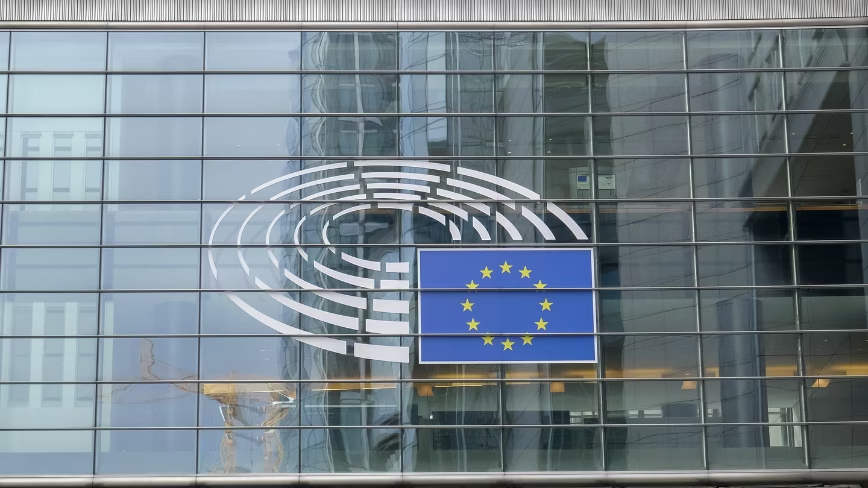
MEPs and their staff are already drafting speeches, questions and amendments with AI. The European Parliament's fix is to give them an official chatbot of its own, so they stop pasting draft laws into public tools.
The European Parliament has a problem with AI, and its answer is more AI. Lawmakers keep using public chatbots to help write legislation. So the institution is building a sanctioned platform to bring that habit under control.
The internal tool, called EPGenAI Hub, will give MEPs and staff access to models from Meta, OpenAI, Anthropic and France’s Mistral. The Parliament is testing it now and could begin the rollout as early as September, Politico reported .
AI has quietly seeped into the daily work of the Parliament. About 2,100 people, roughly 20% of staff, use it every day. The worry is what that is doing to the law.
At a meeting this month, several committee chairs raised the alarm that MEPs and assistants were leaning on AI to draft amendments and other legislative work. The tells are hard to miss: a surge in amendments needing translation, recognisable drafting styles, and the odd hallucinated reference to a law that does not exist.
“Parliament has not been immune to AI slop and misleading AI-generated content,” said Brando Benifei, the lawmaker who steered the EU’s AI Act . “MEPs must lead by example as the AI Act’s transparency rules become applicable.”
The platform lets users pick their model based on how sensitive the task is. Some run inside the Parliament’s own systems, including Meta’s Llama, OpenAI’s GPT-OSS and Mistral Small. Others are more powerful services hosted outside, such as ChatGPT and Anthropic’s Claude Sonnet.
The goal is to stop officials feeding parliamentary material into uncontrolled public apps. The Parliament has already shown it to staff at workshops, one of which promised to help them “work smarter and faster.”
The rules have not kept up. MEPs face no obligation to disclose whether an amendment, question or speech was written with AI. Committee chairs asked the secretary-general to draw up guidelines. They heard the job may instead fall to the constitutional affairs committee, which would have to rewrite the Parliament’s rules.
Staff already have their own rules, from April 2024 and now due for a rewrite. They must label AI-assisted work, and cannot put sensitive information into public AI tools.
Not everyone is comfortable with the drift. Barry Andrews, an Irish Renew MEP, said some colleagues clearly use AI to draft questions, speeches and amendments. “I fully understand, given our workload,” he said. “But for me personally, these are core democratic functions which voters elected us to perform.”
There is an awkward contradiction here. The rollout leans heavily on American AI, even as Brussels pushes to cut its dependence on US technology .
The Parliament has been chasing digital sovereignty elsewhere, swapping Google for the French search engine Qwant and switching off built-in AI on MEPs’ tablets over data-protection fears. Now it is opening its doors wider to US firms .
The mix may not last. The Parliament’s press service said the models on offer are under review. Open-source and EU sovereign models are becoming available through cloud providers the European Commission recently contracted. For now, the institution writing Europe’s AI rulebook is still working out how to use the technology itself.
I am the Editor in Chief for TNW, covering technology not as a parade of launches and valuations, but as a system of influence, persuasion, (show all) I am the Editor in Chief for TNW, covering technology not as a parade of launches and valuations, but as a system of influence, persuasion, and change. I write about startups, venture capital, digital policy, and Europe ecosystem, with an eye on the larger story beneath them: who gets to build the future, who profits from it, and how Europe is learning to speak in a louder voice of its own. Before moving into senior editorial leadership, I've built my career for over +10 years across journalism, storytelling, content strategy, SEO, and digital publishing, with experience in SaaS, hospitality, art, and culture.