
This article was published on July 23, 2024
SuperSharp wants to become the 'killer app' for thermal satellite imagery
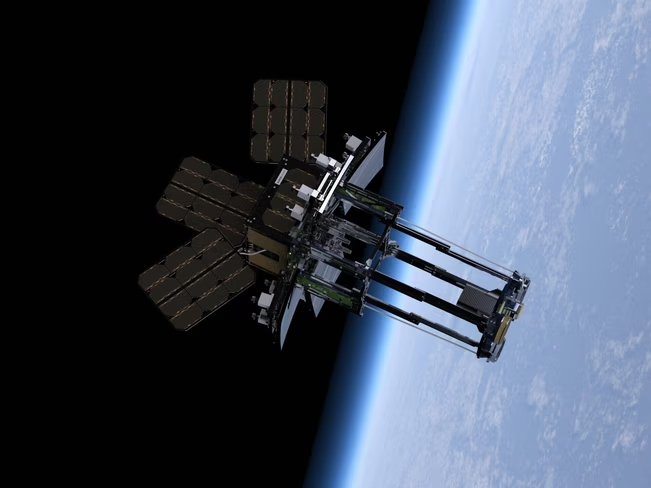
A Cambridge University spin-out is developing a unfolding, heat-detecting telescope that could capture high resolution thermal images of Earth — at an affordable price.
SuperSharp credits these capabilities to its unfolding “self-alignment technology” which allows it to fit big telescopes in small satellites.
Currently, some large, expensive satellites in low-earth orbit can capture high-resolution images infrequently, while small, low-cost satellites capture frequent but low-resolution images. The startup, SuperSharp, wants to occupy the space in the middle.
Unfolding telescopes are nothing new — just look at James Webb for inspiration — but they’re generally very expensive and notoriously tricky to pull off. But SuperSharp believes it can deliver unfolding satellites at a price-point competitive with current Earth Observation satellites.
This could make monitoring everything from buildings to agricultural crops more accessible. According to SuperSharp, the telescope can even identify heat loss at the level of an individual home.
Local authorities could use this data to understand which properties require proper insulation while homeowners could use it to reduce their electricity consumption. The startup says this could make it the “killer app” for thermal satellite imagery.
SuperSharp recently secured £5mn from the UK Space Agency to develop its first in-orbit demonstrator, scheduled to launch in 2026.
Harshbir Sangha, missions and capabilities delivery director at the UK Space Agency, said SuperSharp’s thermal imaging technology could help provide a “clearer picture of heat patterns in cities” and is a “brilliant example” of how investment in space can improve life on Earth.
The funding forms part of a £33mn funding package for over 20 new space projects, announced yesterday by the UK Space Agency.
Eight major projects, including SuperSharp’s, will receive a share of £24mn. This will support projects such as HyImpulse’s suborbital rocket test from SaxaVord spaceport in Shetland and Rolls Royce’s development of micro reactors to power life on the Moon.
The remaining £9mn will fund 15 “Kick Starter” projects, supporting early-stage space technologies from in-orbit servicing to advanced materials development. One startup, BiologIC Technologies, is working on a new way to make medicines in space for use on Earth.
Dr Paul Bate, CEO of the UK Space Agency, said that these projects will help bring the “benefits of space back to citizens on Earth.”
Siôn is a freelance science and technology reporter, specialising in climate and energy. From nuclear fusion breakthroughs to electric vehic (show all) Siôn is a freelance science and technology reporter, specialising in climate and energy. From nuclear fusion breakthroughs to electric vehicles, he's happiest sourcing a scoop, investigating the impact of emerging technologies, and even putting them to the test. He has five years of journalism experience and holds a dual degree in media and environmental science from the University of Cape Town, South Africa. When he's not writing, you can probably find Siôn out hiking, surfing, playing the drums or catering to his moderate caffeine addiction. You can contact him at: sion.geschwindt [at] protonmail [dot] com