
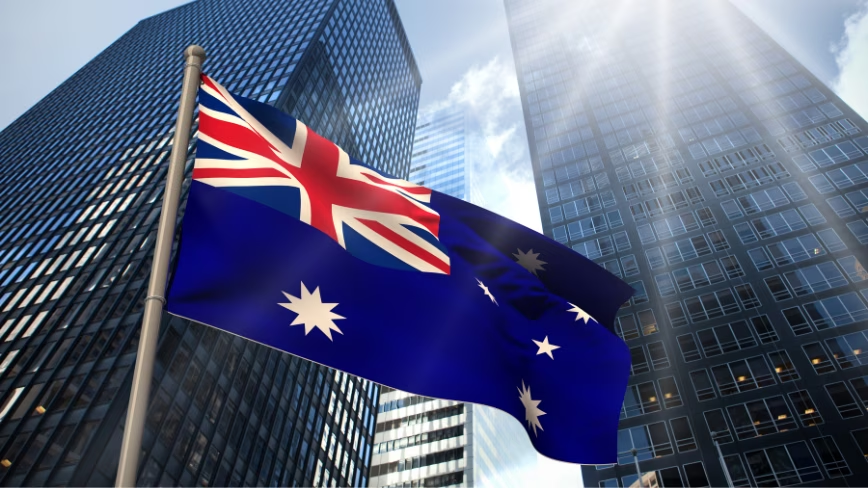
New legislation would lift the maximum penalty to A$99m and let the eSafety Commissioner compel board minutes and internal emails from platforms.
Six months after Australia became the first country to bar under-16s from social media, the government has concluded that the platforms are not taking the rule seriously enough, and is preparing to make the consequences of ignoring it considerably more expensive.
New legislation announced this week would roughly double the maximum penalty for a systemic breach, raising it from A$49.5m to A$99m, about $68m. It would also hand the eSafety Commissioner sharper investigative teeth, allowing the regulator to demand documents and evidence not only from the platforms themselves but from age-checking companies and app stores as well.
The detail that matters most is what those documents could include. Under the proposed powers, the commissioner would be able to compel internal material such as company board minutes and internal emails, the kind of evidence that turns a regulatory suspicion into a case that holds up. The stated aim, per the government, is to ensure the legal actions being built against non-compliant platforms are as strong as possible.
That framing makes the intent plain. The government is not gathering powers for some hypothetical future enforcement. It is gathering them because it intends to enforce, and wants the evidentiary footing to do so.
The ban took effect on 10 December under the Online Safety Amendment Act, and the government says more than five million accounts held by under-16s have since been blocked.
The regulator is investigating possible breaches by Facebook, Instagram, Snapchat, TikTok, and YouTube, the five platforms at the centre of the regime. Earlier compliance work found the platforms had not taken the “reasonable steps” the law requires, a finding that we covered when Australia flagged the companies for non-compliance .
The gap between the headline numbers and the lived reality has been the regime’s persistent embarrassment. Millions of accounts deactivated reads well in a press release, but the regulator’s own assessment found that a large share of children who used social media before the ban still had access to an account afterwards, a pattern explored in our look at why the rule works on paper more than in practice .
Tougher fines and stronger evidence-gathering are the government’s answer to that gap.
Communications Minister Anika Wells has been blunt about the motive she ascribes to the platforms, arguing they are doing the bare minimum because they want the laws to fail. The new penalty regime is calibrated against exactly that calculation: a fine large enough that compliance becomes cheaper than the risk of being caught not complying.
Australia’s experiment is being watched well beyond its own borders. More than a dozen countries have signalled interest in similar restrictions since December, and several, including the UK, are weighing measures that reach into gaming and AI chatbots as well as social feeds. What Canberra does with its enforcement powers now functions as a live test of whether such bans can be made to bite.
The legislation has not yet passed, and the timetable for the higher penalties and expanded powers will depend on its passage through parliament. The companies, for their part, have generally said they are working to comply. Australia’s next move is to make sure it can prove whether they are.
I am the Editor in Chief for TNW, covering technology not as a parade of launches and valuations, but as a system of influence, persuasion, (show all) I am the Editor in Chief for TNW, covering technology not as a parade of launches and valuations, but as a system of influence, persuasion, and change. I write about startups, venture capital, digital policy, and Europe ecosystem, with an eye on the larger story beneath them: who gets to build the future, who profits from it, and how Europe is learning to speak in a louder voice of its own. Before moving into senior editorial leadership, I've built my career for over +10 years across journalism, storytelling, content strategy, SEO, and digital publishing, with experience in SaaS, hospitality, art, and culture.