
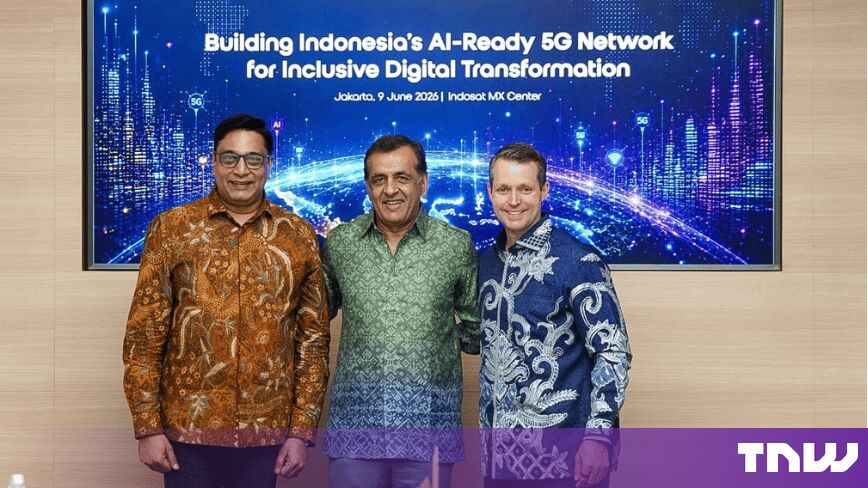
A Qatari telecoms group is leading an $800m investment to build Indonesia's first dedicated AI cloud. It is Gulf money, Nvidia chips, and a Southeast-Asian scramble for sovereign AI, all in one deal.
The platform is called Zankore, and it launched in Jakarta on Thursday. Ooredoo Group, majority-owned by the Qatari state, is the lead investor, with a 49% stake and an $800m commitment over five years. Its partners are Indonesia’s Indosat, plus Nvidia and Nokia.
The ambition is large. Zankore aims to contract 1 gigawatt of AI capacity within three years, built on Nvidia’s DSX “AI factory” architecture. The first 200 megawatts arrive in the first half of 2027. Demand for that capacity, the company says, already outstrips supply.
Each partner brings one piece. Ooredoo supplies the capital and regional scale. Indosat, Indonesia’s second-largest mobile operator, brings the local market and execution. Nvidia provides the GPUs, software, and its Indonesian foothold . Nokia supplies the AI-native networking that ties it together.
For Ooredoo, this is a reinvention. “We’ve been positioning ourselves for a good 36 months to migrate from a traditional telco to a leading digital infrastructure provider,” group chief executive Aziz Aluthman Fakhroo told Fortune . It is a move telcos worldwide are making as their core business stalls.
The numbers the group put forward are striking. Zankore is forecast to generate about $13bn in revenue and $9bn in cumulative EBITDA over five years, with Ooredoo’s share of that profit near $600m. Those are projections, on capacity funded through a mix of equity and debt.
The bet rests on a region running short of compute. Southeast Asia’s data-centre power demand is set to roughly quadruple by 2035, on Wood Mackenzie’s numbers, as AI workloads pile up. Indonesia offers land, a young digital population, and cheap power from gas to hydro. Jakarta already hosts AWS, Google, and Microsoft.
Zankore’s other pitch is sovereignty. Governments across the region increasingly want their own sovereign AI , computing they control rather than rent from American hyperscalers. Indonesia’s digital minister backed the launch, and the platform will host a local model, Sahabat-AI. Nvidia calls these builds national “AI factories,” the label it also puts on Stargate-style projects.
The promise invites scepticism. Ooredoo is not the only telco or fund chasing this. It is a crowded neocloud race, and Gulf capital is pouring into AI infrastructure from Japan to Jakarta. The five-year forecasts assume demand holds and power stays cheap. Fakhroo named the real test himself: not who can build capacity, but who can run it most efficiently.
Cristian Dina is the CRO at The Next Web. He has interviewed 300+ industry leaders and authored the book King of Networking, establishing hi (show all) Cristian Dina is the CRO at The Next Web. He has interviewed 300+ industry leaders and authored the book King of Networking, establishing himself as one of the most connected and respected voices in the ecosystem. At just 23 years old, Cristian was included in the Forbes 30 Under 30 2025 list, representing a new generation of tech builders, bold thinkers who move fast, build with purpose, and create real impact.