
This article was published on March 11, 2026
Temasek and the Grundfos Foundation have joined the fund as it passes its latest target, part of a broader push to channel institutional capital into water technology innovation.
Water scarcity is not a future problem. It is a present one, already constraining agriculture, industry, and urban planning across multiple continents.
What has lagged, historically, is the venture capital infrastructure to fund companies addressing it. Emerald Technology Ventures , a Swiss firm with two decades in the sector, has been trying to change that.
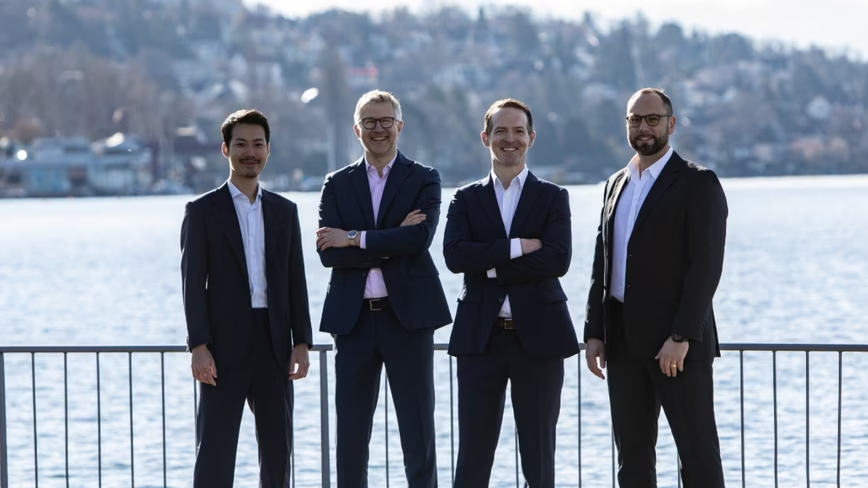
The Zurich-based firm announced this week that its Global Water Fund II has reached €100 million, following the addition of two significant investors: Temasek, Singapore’s state investment company, which was already a cornerstone backer in Emerald’s first water fund, and the Grundfos Foundation, the owner of Grundfos, the world’s largest pump manufacturer, headquartered in Denmark.
Previous investors in the fund include Veralto Corporation, Ecolab, SKion Water, and Oxy Technology Ventures.
The fund held its first close at €60 million in late 2025 . The progression to €100 million brings it to two-thirds of a stated final target, though Emerald has not disclosed a cap or a timeline for the full close.
Why water is attracting institutional capital
Water technology has historically been an unglamorous corner of the venture landscape, critical but unsexy, with long development cycles and regulatory complexity that deters the fast-moving capital that has flocked to AI and consumer software.
What is changing is the combination of physical urgency and industrial demand. The companies backing Emerald’s fund are not philanthropists. They are industrial players, Ecolab, Grundfos, Veralto, whose own businesses depend on the availability and quality of water, and who have economic incentives to see the technology advance.
Temasek’s return to the fund is particularly notable. Singapore has spent decades treating water security as a national priority, the country imports a significant proportion of its water from Malaysia and has invested heavily in desalination and recycling infrastructure. An investment through Temasek in a global water technology fund is consistent with that strategic posture.
Emerald itself was founded in 2000 and manages over €1 billion in assets from offices in Zurich, Toronto, and Singapore. The firm invests in startups tackling climate change and sustainability broadly, but water has become an increasingly central focus.
Global Water Fund II’s portfolio companies are not disclosed in detail, but the firm’s investment thesis centres on innovations in water treatment, efficiency, and monitoring, categories where the gap between what is technologically possible and what is commercially deployed remains wide.
The broader message of the fund’s momentum may be as significant as its specific portfolio: institutional capital is beginning to treat water technology as infrastructure investment, not philanthropy.
Whether that shift is happening quickly enough to match the pace of water stress globally is a different question, and not one a €100 million fund, however well deployed, can answer on its own.
Alina Maria Stan builds connections that people actually feel. As co-founder and COO of Tekpon, she turns product intuition into real moment (show all) Alina Maria Stan builds connections that people actually feel. As co-founder and COO of Tekpon, she turns product intuition into real moments of discovery, shaping how teams find and adopt SaaS every day. Since 2020, she has led Tekpon’s brand voice, media strategy, and growth plays with a clear focus on human outcomes behind every metric. Before Tekpon, Alina followed curiosity across industries and countries. She was CEO of King Casino Bonus and led affiliate and brand strategy at Extremoo Media and Fable Media in Denmark, where she learned how to build partnerships that last. Early on, she sharpened her CRM and pricing instincts at K.H. ApS, always asking why customers choose what they choose. Her approach is rooted in more than a decade of international experience and two master’s degrees, one in Sustainable Consumption from the Technical University of Munich and one in Consumer Affairs Management from Aarhus University.