
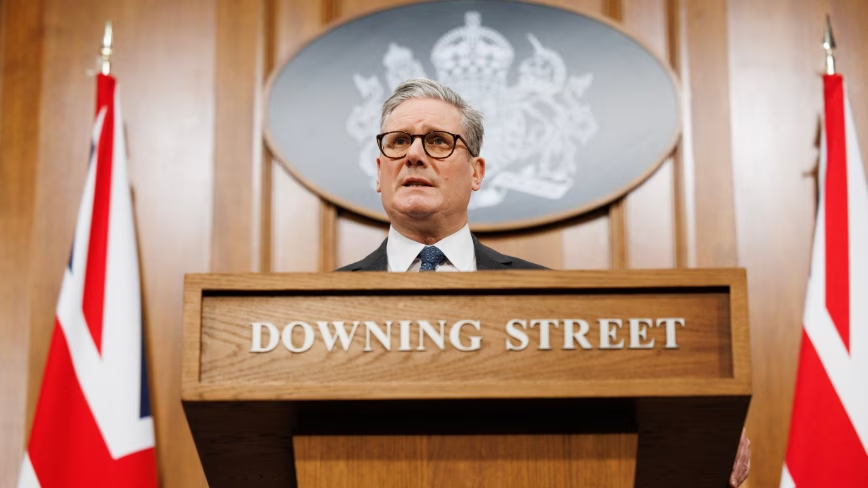
Keir Starmer is expected to go beyond Australia’s model, with curbs reaching into gaming apps and AI chatbots.
Britain is expected to set out restrictions on how children under 16 use social media, in a package that could ban access to the main platforms and curb features judged too addictive for young users, according to reporting on the government’s plans.
Prime Minister Keir Starmer is said to have decided to go further after speaking to parents and weighing the evidence from Australia, which introduced its own under-16s ban last year.
The plan, as described by the Guardian, would bar all under-16s from the main social media platforms. Products not classed as social media, gaming apps among them, would face their own restrictions rather than a ban, including measures to stop children being contacted by strangers.
Reporting has also pointed to evening curfews and limits on AI chatbots as part of what officials have framed as an “Australia-plus” approach.
The latest rumblings from the EU tech scene, a story from our wise ol' founder Boris, and some questionable AI art. It's free, every week, in your inbox. Sign up now!
The legislative hook already exists. Part 3 of the Children’s Wellbeing and Schools Act 2026 requires the government to impose some form of age or functionality restriction for under-16s, which means the question facing ministers is the shape of the rules rather than whether to make them. A public consultation is part of the process, putting the specifics to parents before the detail is fixed.
Britain would not be acting alone. Australia’s ban is the reference point ministers keep returning to, and Malaysia has said it intends to bring in its own under-16s restrictions. The pattern is a cluster of governments arriving at similar conclusions about children and the major platforms within roughly the same window.
The reach into gaming apps and AI chatbots is the part that takes the proposal past a straightforward platform ban, since it brings products that are not social networks in the usual sense inside the regime.
Chatbots in particular are a newer worry for regulators than the feeds the debate began with, and including them signals that ministers are trying to write rules for a landscape that has moved since the first online-safety laws were drafted.
The harder questions are practical. Age verification at this scale has proved contentious wherever it has been tried, raising the prospect of either intrusive identity checks or systems that are easy for a determined teenager to evade.
Australia’s rollout, the model ministers keep citing, has itself drawn scrutiny over exactly these points, which is the experience the British consultation will be reading closely. Industry groups have argued that blunt age limits push children towards less-regulated corners of the internet rather than off it, a counter-argument ministers will have to weigh against the parental pressure driving the policy.
How any of it is enforced, and how age is verified without sweeping up adults, is the work that consultation and secondary legislation will have to do. The announcement sets the direction. The mechanics come after.
I am the Editor in Chief for TNW, covering technology not as a parade of launches and valuations, but as a system of influence, persuasion, (show all) I am the Editor in Chief for TNW, covering technology not as a parade of launches and valuations, but as a system of influence, persuasion, and change. I write about startups, venture capital, digital policy, and Europe ecosystem, with an eye on the larger story beneath them: who gets to build the future, who profits from it, and how Europe is learning to speak in a louder voice of its own. Before moving into senior editorial leadership, I've built my career for over +10 years across journalism, storytelling, content strategy, SEO, and digital publishing, with experience in SaaS, hospitality, art, and culture.