
This article was published on April 30, 2024
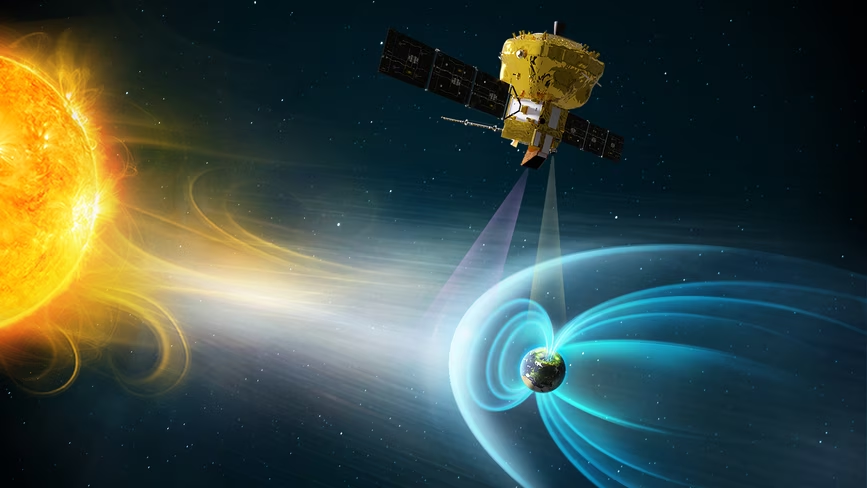
The Smile satellite will capture the world’s first X-ray images of solar wind
The European Space Agency (ESA) has secured a ride for its solar wind satellite.
The Solar wind Magnetosphere Ionosphere Link Explorer — or Smile for short — will blast into space aboard a Vega-C rocket. The launch is scheduled for late 2025 from Europe’s spaceport in French Guiana.
“We are delighted to be launching Smile on such a versatile launch vehicle,” said David Agnolon, project manager of Smile. “Vega-C has been selected as it perfectly matches the needs of the mission, such as required mass capability and injection orbit.”
Vega-C will position Smile in a low-Earth orbit, after which the spacecraft will propel itself into an oval-shaped orbit 121,000 kilometres above our home planet. From this vantage point, scientists will be able to observe the northern polar regions for more than 40 hours at a time.
Smile will take the world’s first X-ray images and videos of solar wind slamming into Earth’s magnetic field. Using an ultraviolet camera, Smile will also give us the longest-ever continuous look at the northern lights.
The latest rumblings from the EU tech scene, a story from our wise ol' founder Boris, and some questionable AI art. It's free, every week, in your inbox. Sign up now!
The Earth’s magnetic field acts as a giant shield against harmful solar rays. Without it, humanity would be exposed to potentially life-threatening radiation and cosmic rays. Power grids and satellites would malfunction.
Smile was developed by ESA a nd the Chinese Academy of Sciences (CAS) to deepen our understanding of these phenomena.
The partners designed and built the probe, and will operate it together. It marks Europe and China’s first entirely joint space mission.
“Several technical and programmatic difficulties have been jointly overcome by ESA and CAS teams through efficient and respectful collaboration,” says Frédéric Safa, head of ESA’s Future Missions Department.
The European and Chinese sections of the spacecraft are expected to arrive at ESA’s technical centre at Noordwijk , the Netherlands, later this year. Here, the two sections will be joined together. After which the spacecraft will be tested for the first time.
Developed by ESA and the Italian Space Agency, Vega-C is Europe’s next-gen rocket for delivering small payloads to space. First launched in July 2022, it has been grounded since March 2023, following a launch failure . It is expected to take off again later this year — if all goes to plan.
Siôn is a freelance science and technology reporter, specialising in climate and energy. From nuclear fusion breakthroughs to electric vehic (show all) Siôn is a freelance science and technology reporter, specialising in climate and energy. From nuclear fusion breakthroughs to electric vehicles, he's happiest sourcing a scoop, investigating the impact of emerging technologies, and even putting them to the test. He has five years of journalism experience and holds a dual degree in media and environmental science from the University of Cape Town, South Africa. When he's not writing, you can probably find Siôn out hiking, surfing, playing the drums or catering to his moderate caffeine addiction. You can contact him at: sion.geschwindt [at] protonmail [dot] com