
This article was published on September 2, 2024
Enerpoly thinks it has what it takes to take on lithium-ion
Swedish startup Enerpoly has opened the world’s first zinc-ion battery megafactory. Its vision is to scale a better alternative to lithium-ion for storing renewable energy over longer periods of time.
The Enerpoly Production Innovation Center (EPIC) facility is located north of Stockholm. Commissioning has already begun and the plant is expected to make the first zinc-ion batteries next year. The company aims to reach a maximum production capacity of 100MWh by 2026 — enough energy to power around 20,000 homes.
In 2018, Dr. Mylad Chamoun made a breakthrough in zinc-ion battery chemistry while pursuing his PhD at Stockholm University. Later that year, he teamed up with his former classmate Dr. Samer Nameer and the duo founded Enerpoly. The partners saw a gaping hole in the market where lithium-ion wasn’t competitive — offering 2 to 10 hour energy storage. They believed zinc-ion batteries could fill the gap.
Using zinc in batteries isn’t anything new. The AA batteries that power your most precious (read, junk) toys and gadgets are made from zinc and manganese oxide. This chemistry has made companies like Energizer and Duracell a tonne of money.
The latest rumblings from the EU tech scene, a story from our wise ol' founder Boris, and some questionable AI art. It's free, every week, in your inbox. Sign up now!
However, zinc-ion batteries have historically, for lack of a better word, sucked at recharging. This is because zinc-ion chemistries are plagued by dendrites — crystals that cause short circuits. They also lose capacity fast.
“Enerpoly has innovated across the entire zinc-ion battery system — including anode, cathode, electrolyte, and separator design — to solve these inherent problems,” the company’s CEO, MIT-educated aerospace engineer Eloisa de Castro, told TNW.
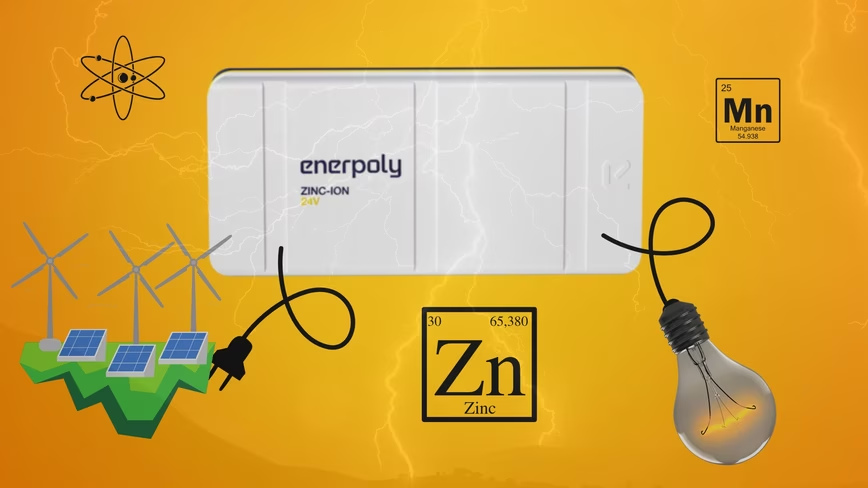
Enerpoly uses zinc metal for the battery’s anode, manganese dioxide for the cathode, and a water-based electrolyte to carry charged particles between the two sides.
Unlike lithium, zinc is globally abundant. Moreover, Sweden is home to the largest zinc reserves in Europe — about 2% of the world’s total. Enerpoly hopes to establish a completely European supply chain for its batteries and make the continent a “zinc-ion powerhouse.”
Different from lithium-ion battery developers, Enerpoly is targeting the energy storage market – not EVs and smartphones. Use cases include renewable energy storage, shifting energy loads on the grid, and increasing power resiliency — within the 2-10 hour storage mark.
The batteries are modular — multiple packs can be placed in parallel to make larger systems. The company claims the packs are non-toxic, non-flammable, and non-explosive.
Because the materials they use are a lot more abundant, Enerpoly believes it can be cost-competitive with myriad other short-to-mid term energy storage technologies under development. These include lithium-ion batteries, thermal heat storage devices, liquid air batteries , iron flow batteries , gravity batteries , and even this CO2 dome .
And investors seem to agree. To date, the company has raised just shy of €15mn. Over €8mn of that came from the Swedish Energy Agency to construct the EPIC factory.
CEO De Castro told TNW the company is also planning to close its Series A this year, as they look to scale up towards the 2026 target of 100MWh. In July, Enerpoly acquired state-of-the-art dry electrode manufacturing equipment from bankrupt startup Nilar that it will use in its new plant. Beyond 2026, the startup is eyeing its first gigafactory.
Siôn is a freelance science and technology reporter, specialising in climate and energy. From nuclear fusion breakthroughs to electric vehic (show all) Siôn is a freelance science and technology reporter, specialising in climate and energy. From nuclear fusion breakthroughs to electric vehicles, he's happiest sourcing a scoop, investigating the impact of emerging technologies, and even putting them to the test. He has five years of journalism experience and holds a dual degree in media and environmental science from the University of Cape Town, South Africa. When he's not writing, you can probably find Siôn out hiking, surfing, playing the drums or catering to his moderate caffeine addiction. You can contact him at: sion.geschwindt [at] protonmail [dot] com