
This article was published on February 26, 2024
The device uses mirrors to maximise electricity and heat generation
European scientists have developed a solar module that can produce electricity and heat at the same time — in a potential breakthrough for low-cost clean energy generation.
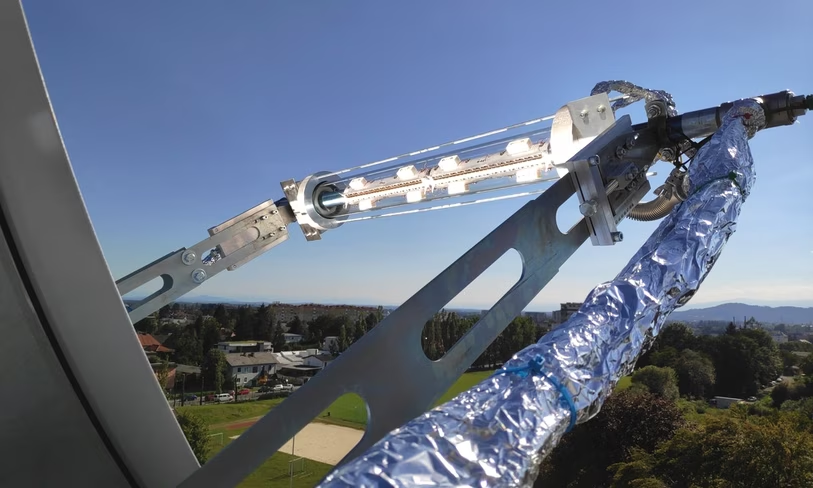
The device is made up of a concave mirror and a thin, glass tube filled with photovoltaic cells. When the sun’s rays strike the module, the mirror reflects them at the tube, generating electricity.
The heat produced in the tube then warms up a transfer fluid that flows along the back of the solar cells in a system of pipes. This warm liquid can be used for heating and cooling buildings or for industrial applications.
“This approach has the potential to make a significant contribution to the energy transition,” said lead researcher Armin Buchroithner from the Graz University of Technology in Austria.
The latest rumblings from the EU tech scene, a story from our wise ol' founder Boris, and some questionable AI art. It's free, every week, in your inbox. Sign up now!
The idea of capturing both electricity and heat from solar radiation has been around since the 1970s, but technological barriers and high costs prevented scientists from making concrete developments — until now.
Buchroithner’s team has made a couple of key technological breakthroughs that make it a lot cheaper to build these hybrid systems.
By concentrating the sun’s energy, t he mirror amplifies the solar radiation by a factor of 60 to 120 times. This means far fewer solar cells are needed to produce the same amount of energy.
As the researchers highlighted in a separate paper , at high production volumes, mirrors can be acquired for €2 to $5 per square metre, while PV panels range from €70 to $100 per square metre.
The researchers, in partnership with the Turkish research centre GÜNAM, developed silicon solar cells specifically designed to withstand the high temperatures of concentrated sunlight. This is an important factor, since standard solar cells struggle to produce electricity efficiently in hot conditions.
“Given the rising energy prices and the desire for energy independence, the importance of independent, efficient, and cost-effective solutions for the supply of electricity and heat is increasing,” Buchroithner said.
The development comes at a time when scientists and companies alike are exploring new ways to harness the power of the sun.
Just this month, a UK startup developed the world’s most efficient solar panel , while European joint venture Thales Alenia Space is exploring plans to beam solar power from orbit .
Siôn is a freelance science and technology reporter, specialising in climate and energy. From nuclear fusion breakthroughs to electric vehic (show all) Siôn is a freelance science and technology reporter, specialising in climate and energy. From nuclear fusion breakthroughs to electric vehicles, he's happiest sourcing a scoop, investigating the impact of emerging technologies, and even putting them to the test. He has five years of journalism experience and holds a dual degree in media and environmental science from the University of Cape Town, South Africa. When he's not writing, you can probably find Siôn out hiking, surfing, playing the drums or catering to his moderate caffeine addiction. You can contact him at: sion.geschwindt [at] protonmail [dot] com